
Part 2 — The Hour Otis Never Missed
My name is Amos Bell. I was seventy-two that November, and I had worked at Maple Hill Cemetery for twenty-nine years—first as a groundskeeper, then as caretaker after my knees became too stiff for twelve-hour days behind a mower.
I lived in a two-room stone cottage behind the chapel. The cottage had one narrow bed, a gas stove that clicked three times before lighting and two coffee mugs even though only one had been used since my wife, June, died six years earlier.
June was buried forty-seven paces from the cottage door.
I knew because I had counted.
I visited her grave every Sunday after locking the eastern gate. I pulled weeds, cleaned her marker and sometimes told her which maple had lost a limb during the week. I never stayed long enough for silence to become a conversation.
Otis handled silence differently.
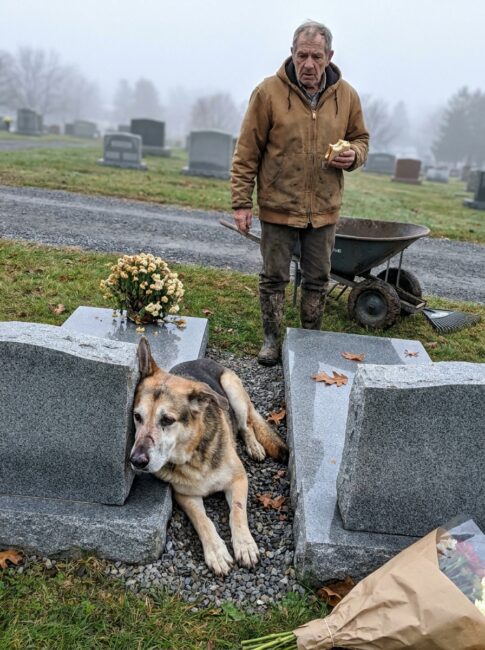
The first morning after I discovered his name, he arrived at 4:11 and walked directly to the Harrows’ graves. A light rain made the stones shine beneath the security lamp. He circled once, lowered himself between them and leaned toward Thomas.
At 5:12, he stood.
I checked my watch.
One hour and one minute.
The next morning, he leaned toward Evelyn for sixty minutes. The morning after that, he returned to Thomas. He did not need a command, a smell trail or an object placed beside either stone. He followed an order carried inside his own routine.
The cemetery records showed that Otis’s first known appearance had occurred on March 14, three days after Evelyn’s burial. A temporary worker named Caleb had written, large brown-and-black dog near Harrow plot. Chased beyond east fence.
The next entry came on March 16.
Same dog returned.
Then March 17.
Dog would not leave. Placed water by shed.
Caleb stopped writing after that. He had assumed the dog wandered among the grounds, and nobody had noticed the alternating sides. By the time I began recording the pattern in November, Otis had been coming for almost eight months.
He had kept more than two hundred appointments without anyone understanding what he was doing.
I moved his food pan beneath my porch roof and added an old army blanket. Otis ate there but refused to sleep inside the cottage. At dusk, he walked back through the fence and disappeared beneath the loading dock.
I followed him with a flashlight on November 26.
His shelter consisted of flattened cardboard, a torn shower curtain and a child’s faded red sweatshirt. Two empty food cans sat near the wall. Somebody had fed him before I did, though the cans were months old.
A rubber ball rested beneath the sweatshirt.
When I picked it up, Otis stepped between me and the shelter. He did not growl. He simply looked at my hand until I returned the ball.
“Fair enough,” I said.
His folded ear lifted.
The following day, I searched the address listed on his tag. The Harrow house stood 6.8 miles from the cemetery in a neighborhood of narrow brick homes south of Scranton. A foreclosure notice covered one window. Dead leaves had collected against the porch steps.
A neighbor named Alice Moreno remembered Otis.
“He belonged to both of them,” she said. “That matters.”
Alice explained that Thomas had suffered a stroke three years before his death. He walked with a cane and lost strength in his left hand. Evelyn developed severe arthritis and could no longer stand for long periods.
Otis learned to move between them.
“He checked Tom’s bedroom first every morning,” Alice said. “Then he went to Evelyn’s chair. At night, he lay between their recliners. If one got up, he followed until that person sat down again.”
“Who took him after Evelyn died?”
Alice folded her arms against the cold.
“Family came for furniture. I saw the dog placed in a van.”
“Which family member?”
“I don’t know. Two men and a woman. They argued in the driveway.”
Three days later, Otis had reappeared on the Harrows’ porch. The house was locked. He slept on the top step until a bank representative removed him. After that, Alice stopped seeing him.
By then, he had found the cemetery.
Before I left, Alice went inside and returned with a photograph. Thomas sat in a blue porch chair. Evelyn sat in a green chair beside him. Otis lay across the floorboards with his body between them, but his head rested on Thomas’s shoe.
On the back, Evelyn had written:
Monday—Tom’s turn. Tuesday—mine. Otis keeps us fair.
Alice watched me read it.
“They joked about him choosing favorites,” she said. “So they took turns calling him to their chairs. Tom got odd-numbered days. Evelyn got even.”
I looked at the date printed beneath the photograph.
May 17, 2021.
An odd-numbered day.
Otis had rested his head on Thomas’s shoe.
The behavior had not begun among the graves.
The graves were where the old routine had continued after the chairs were gone.
Part 3 — Three Months Between the Funerals
Thomas Harrow died at 2:36 on a Monday morning in December. Alice knew the time because Evelyn called her before she called either of her children.
Otis had been sleeping between their recliners. When paramedics entered, he followed the stretcher through the front room and stopped at the porch step after Evelyn told him to stay.
He remained there until the ambulance disappeared.
For the next nine days, Otis waited beside Thomas’s empty blue chair at 7:00 each evening. Evelyn tried moving the chair into the basement, but he stood where it had been and stared at the bare patch in the rug.
She brought the chair back.
At Thomas’s funeral, Otis was left at home because Maple Hill did not allow loose animals during services. Alice stayed with him. She said he paced from the front door to Thomas’s bedroom seventeen times before lying against Evelyn’s green chair.
That evening, Evelyn returned wearing a black wool coat. She sat without removing it. Otis placed his head across her shoes, though the calendar said it should have been Thomas’s turn.
He did not alternate again while only Evelyn remained.
He stayed with her.
This was the first detail I misunderstood. I had assumed Otis followed dates as though numbers lived inside his head. The truth was simpler. Alternating had belonged to two people. When one disappeared, the dog no longer divided his time.
Evelyn’s health fell quickly after the funeral. She stopped cooking and lived on canned soup, toast and meals Alice carried across the street. Her hands shook when she fastened Otis’s collar, so Alice began walking him each afternoon.
Otis shortened his stride for Evelyn. If she moved from the green chair to the kitchen, he rose beside her left knee. When she stopped to catch her breath, he stopped before the leash tightened.
Richard visited twice. His sister, Caroline, came once with her twenty-one-year-old daughter, Leah. They sorted documents at the dining table while Evelyn slept upstairs.
The family did not argue about Otis then. They argued about the house.
Thomas had borrowed against it after Richard’s construction business failed. Caroline had co-signed one loan without telling her husband. Money passed between family members for years until nobody agreed on who had helped whom.
The Harrow house became a ledger.
Every chair carried an accusation. Every drawer held a receipt. Thomas’s death did not end the old dispute; it removed the only person who remembered how it had begun.
Otis walked from one voice to another, touching each knee with his nose.
Nobody touched him back.
On February 3, Evelyn fell beside the kitchen sink. Otis barked until Alice crossed the street and found her gripping the cabinet handle. The ambulance took Evelyn to Geisinger Community Medical Center with a fractured wrist and pneumonia.
Otis waited on the Harrow porch for six hours.
Alice brought him home that night. He ate little and slept facing her front door. Each time headlights crossed the ceiling, his standing ear rose.
Evelyn returned ten days later. She could no longer manage the stairs, so a hospital bed was placed in the dining room. Otis slept beneath it, pressing one shoulder against the metal frame.
The green chair stood three feet away.
On March 10, Evelyn asked Alice to open the curtains because she wanted to see whether the crocuses had appeared. Only two had broken through the cold soil.
Otis lay with his chin across Evelyn’s ankle.
She ran two fingers along his white muzzle.
“Your father will think I kept you all to myself,” she told him.
Alice heard it from the kitchen.
Evelyn died the next morning at 5:12.
The time mattered.
At 5:12 each day, Otis later rose from between the graves.
That was the second detail I had missed. His hour at Maple Hill did not end at a random moment. It ended at the minute Evelyn’s breathing had stopped and the room had filled with the hum of an oxygen machine nobody needed anymore.
After the ambulance left, Otis did not move from the dining-room floor. He pressed against the green chair until Richard arrived that afternoon.
The family meeting lasted ninety minutes.
Caroline wanted Otis placed with a rescue because her apartment prohibited large dogs. Richard said the county shelter would be faster. Leah offered to take him temporarily, but she lived in a college dorm and had no legal place to keep him.
Nobody wanted to be the person who drove him away.
Richard finally clipped on the green leash.
Otis followed him to the van because he had been taught to follow that leash.
The first home belonged to Richard’s business partner. Otis stayed there for six days. He scratched one door until the wood split, slipped his collar during a walk and traveled four miles toward the Harrow house before police found him.
The second home belonged to a cousin in Wilkes-Barre. Otis refused food for two days and jumped a five-foot fence on the third.
Richard picked him up.
Instead of returning to the house, he drove Otis to a private boarding kennel and paid for one week. When the week ended, the family stopped answering the kennel owner’s calls.
The owner called Richard from another number.
Richard came after dark, paid part of the bill and took Otis away.
What happened next never appeared in any family account. Richard claimed he left Otis with a farm outside Clarks Summit. The farm owner said no dog matching Otis had ever arrived.
The child’s sweatshirt beneath the loading dock gave me the missing piece.
Leah had taken Otis from Richard’s van before the supposed farm visit. Unable to bring him into her dorm, she slept beside him for two nights in her car and tried twelve rescues. Every kennel was full.
On the third morning, campus security ordered her to remove the dog.
Leah drove to Maple Hill because she believed Otis might calm down after visiting the Harrows’ graves.
She brought the red sweatshirt, the rubber ball and two cans of food.
Otis found the plot without help.
He lay between Thomas and Evelyn.
Leah waited three hours. When she finally clipped on the leash, Otis planted all four paws and lowered his body against the grass. He had never resisted her before.
Leah removed the leash.
“I thought he needed ten more minutes,” she later told me. “Then he needed another ten. After dark, I understood he wasn’t coming with me.”
She returned the next day with food.
Then the next.
She visited for three weeks until Richard learned what she was doing and threatened to stop paying her tuition if she continued “dragging the family backward.” Leah obeyed for two months. After that, she left food beneath the loading dock at night where nobody could see her.
The empty cans were hers.
So was the sweatshirt.
Otis had not been forgotten by every person in the family.
He had been loved by the one person with the least power to keep him.
Part 4 — The Family That Would Not Return
I called Richard again on December 2.
He recognized my number and answered with, “I told you we’re not taking the dog.”
“I’m not asking about the dog yet.”
“What do you want?”
“The truth about the farm.”
The line went quiet.
Richard denied abandoning Otis. He said Leah had interfered, the kennel had become unreasonable, and the dog had rejected every home they tried.
“He chose the cemetery,” Richard said.
“A dog choosing a grave doesn’t remove your responsibility.”
“You don’t know what happened in that house.”
“I know what happened after it became inconvenient to remember.”
Richard’s breath struck the receiver.
He told me Thomas had controlled the family with money. He said Evelyn defended her husband even when the debts damaged both children. After the funerals, neither Richard nor Caroline wanted the house, its furniture or anything connected to the years of arguments.
Otis belonged to those years.
“We don’t want to reopen the past,” he said.
“He isn’t the past. He needs food tonight.”
“Then call a shelter.”
I looked through the office window. Otis sat beneath my porch roof with snow resting along his back because he had not yet learned he was allowed on the blanket.
“Would you sign a surrender form?”
“No.”
“Then legally, he still belongs to the estate.”
“Keep him.”
Richard ended the call.
Caroline answered the following afternoon. She listened longer but gave the same answer.
Her husband had been bitten as a child. Their lease limited pets to twenty-five pounds. Their teenage son had asthma. Some reasons were practical, others defensive, but they led to one sentence.
“We can’t take him.”
I asked whether she remembered the alternating-chair ritual.
Caroline began to answer, then stopped.
“My mother thought it was funny,” she said.
“Otis still does it.”
“Does what?”
“He lies between their graves for one hour every morning. He changes sides each day.”
The silence lasted eleven seconds.
When Caroline spoke again, the words came apart.
“He still switches?”
“Yes.”
“Even now?”
“Every day.”
A breath entered the telephone. Another did not leave for several seconds.
Caroline told me about a kitchen calendar Evelyn kept beside the refrigerator. She marked odd days with a blue dot for Thomas and even days with a green dot for herself. The ritual began after both developed balance problems and Otis nearly knocked Evelyn down while rushing between them.
They trained him to wait until called.
Thomas on odd days.
Evelyn on even.
What started as safety became a family joke. If Thomas called on Evelyn’s day, she would tap the calendar and say, “Stop stealing my dog.”
Otis learned not merely to choose one person. He learned that choosing one required returning to the other.
“Where is the calendar?” I asked.
“In a storage unit.”
“Can I see it?”
“No.”
The word came fast.
Then Caroline said something quieter.
“I don’t go into that unit.”
Before ending the call, she gave me Leah’s number.
Leah drove from State College on Saturday, arriving in a dented blue sedan with a bag of dog food and Otis’s green leash on the passenger seat.
She was twenty-one, thin through the shoulders, with dark curls pushed beneath a knit cap. Otis heard her car door and ran from my porch so quickly that his rear paws slid across frozen grass.
He did not bark.
He struck Leah at the knees, rose against her coat and pushed his white muzzle beneath her chin. Leah crouched with both arms around him. Her hat fell into the snow.
“I’m sorry,” she said into his neck. “I’m sorry I stopped coming.”
Otis held one paw against her shoulder.
I turned toward the tool shed and gave them the privacy of pretending to search for a shovel.
Leah stayed through the afternoon. She brushed burrs from Otis’s tail, checked his paws and showed me photographs from the last years of Thomas and Evelyn’s lives.
In every photograph with both people, Otis occupied the middle.
At the dining table, his head rested on Thomas’s left shoe.
On the porch, his back touched Evelyn’s ankle.
During Christmas, he lay beneath both chairs while wrapping paper covered his tail.
The final photograph had been taken the day before Thomas died. Otis rested between the recliners. His nose pointed toward Thomas, but one hind paw remained against Evelyn’s slipper.
“He always kept contact with both,” Leah said. “Even on one person’s day.”
At 4:11 the following morning, Leah and I stood behind the maple trees while Otis entered through the fence.
The date was December 7.
Odd.
Thomas’s day.
Otis lay between the stones and leaned left.
Leah pressed her glove against her mouth.
At 5:12, Otis rose.
He walked past us and stopped at my cottage.
Then he looked back.
For the first time, he did not head toward the loading dock.