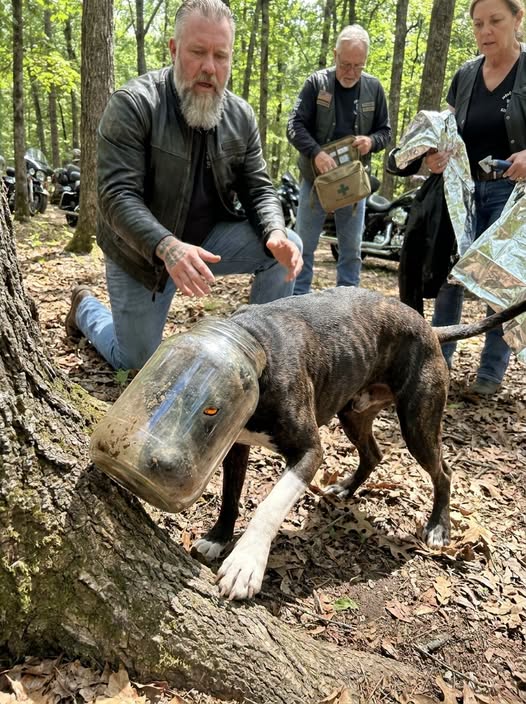
Part 2 — The Trail She Refused to Leave
The object in the dog’s mouth was a piece of bread.
Not a sandwich. Not a fresh roll. It was a dry heel from a cheap white loaf, hardened at the edges and stained with dust from the bottom of the jar. Part of it had turned soft where her saliva reached it through a crack.
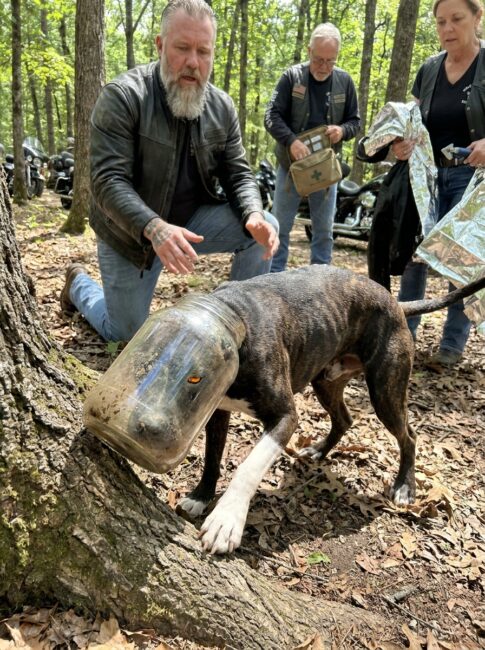
Lena held out the chicken again.
The dog kept the crust.
Red placed water in front of her, but she stepped around it. She stood with her legs spread for balance, lowered her head, and began walking northwest.
She managed six steps.
Then she fell.
I caught her beneath the chest before her face struck the ground. She weighed less than forty pounds, although the width of her paws suggested she should have weighed close to fifty-five. Her coat hid some of the damage, but my fingers found each rib.
“Hospital first,” Red said. “She needs oxygen and fluids.”
He was right.
The dog’s gums remained dusky. Blood marked the skin behind her ears, and each breath entered with a faint whistle. The safest choice was to carry her to the road, load her into our chase truck, and call the nearest emergency animal clinic.
I lifted her.
She twisted with a strength that had not existed thirty seconds earlier. The bread remained clamped gently between her teeth while her front legs reached toward the ground. When I turned south, toward the motorcycles, she struck my chest with one white paw.
“Easy.”
She did it again.
I shifted northwest.
The dog stopped fighting.
Lena noticed first. “Turn back toward the road.”
I did.
The dog pushed against me.
I turned toward the trees.
Her body went still.
Red looked past us into the dense timber. “She’s trying to get somewhere.”
The forest floor sloped into a shallow ravine filled with blackberry canes, storm-fallen branches, and young cedar. No marked trail ran through it. The dog could barely hold up her own head, yet everything in her body pointed toward that rough ground.
We had no leash, so Lena folded a clean bandanna into a loose emergency collar. I carried the dog while she held the bread, and the others walked ahead, clearing branches.
She became our compass.
Whenever Amos chose the wrong opening between the trees, she lifted her muzzle and pulled toward another. If I stopped, her paws moved against my forearm. If I stepped in the correct direction, she rested without wasting strength.
Her nose could not have followed the bread’s scent while trapped inside glass. Swelling and dried saliva had nearly sealed the jar against her neck. She was following something else—memory, sound, or a route she had traveled before.
Twenty yards from the rescue site, we found the first mark.
A curved line crossed a patch of red clay where pine needles had been washed aside by rain. The groove was four inches wide. Small chips of glass glittered within it.
The jar had dragged there.
Beside the groove lay a paw print with blood in its center.
We followed the marks downhill. Some trees carried pale half-moon scratches ten inches above the earth, all at the height of the jar’s widest point. The marks ran both ways.
One set led toward the place where we had found her.
A fainter set came from the northwest.
“She was already coming from this direction when her head got stuck,” Lena said.
Red crouched beside a broken blackberry cane. A small patch of brindle fur clung to one thorn.
“Then she tried to go back the same way.”
The dog heard his voice and pushed her paw toward the ground.
I set her down for a moment. Her knees shook, but she walked to the groove and followed it without searching. The crust remained untouched between her teeth.
We went another thirty yards.
Heat collected beneath the trees. Mosquitoes gathered around the raw ring on her neck, and Lena brushed them away while walking beside her. Red called the Greene County animal emergency clinic and described the dog’s breathing.
“Get her here now,” the veterinarian told him.
Red looked at me.
I looked at the dog.
The medical choice was clear, but the animal kept showing us that removing her from the forest would leave something unfinished. She had nearly died trying to travel in this direction. The bread could not explain that by itself.
I called our club president, Warren Tate, who had stayed near the road with the support truck because of a bad knee.
“Bring the truck to the logging spur and contact a ranger,” I said. “Tell them we may have more than one animal.”
“How many?”
“I don’t know.”
The dog moved another ten feet and stumbled beside a shallow print in the mud. It was smaller than my thumb.
Not an adult paw print.
A puppy’s.
Rain had softened its edges, but three more prints crossed the clay beyond it. The dog lowered her nose to them. The bread touched the mud, and she lifted it quickly before continuing.
Red stared at the small tracks.
“Ray.”
“I see them.”
We did not say what we were beginning to suspect. The forest remained too large, the tracks too old, and the dog too close to collapse.
Still, every one of us started walking faster.
The route bent around a limestone outcrop and entered thicker cedar. The dog could no longer stand, so I lifted her again. She did not resist as long as I followed the scratched trees.
Fifty yards later, we reached a dried creek bed. The jar’s curved groove vanished among the stones, yet the dog immediately turned left.
She knew the way.
A rusted tin bowl lay beneath a sycamore near the creek, crushed flat on one side. No food remained inside it. Ants moved along the rim.
Lena picked it up.
“Someone fed dogs here.”
“Or dumped them here,” Red said.
The dog released a faint sound around the bread.
I had heard frightened animals whine. This was different—short, repeated, controlled. A call.
Something answered from deeper in the trees.
The sound was so weak I first mistook it for a bird.
Then it came again.
Four thin notes, one after another.
The dog tried to jump from my arms.
Part 3 — Two Hundred Meters Through the Trees
We entered the cedar thicket in single file.
The branches grew low enough to scrape our shoulders, and dry needles turned the slope beneath us into loose ground. I carried the dog against my chest while Lena kept one hand beneath her rear legs. Red walked ahead with a flashlight even though daylight still filtered between the trees.
The small cries stopped whenever we moved.
Then the dog called.
The answer came again.
Four voices.
A few men in our club had been called dangerous because of how we looked. Amos had a skull tattoo left from a younger life. I had old prison-style ink across one forearm, though I had never been inside a prison. Warren stood six feet five and weighed close to three hundred pounds.
Yet those four tiny sounds stopped every one of us.
We listened.
The dog pushed forward.
The distance from the broken jar to the cedar thicket measured just over two hundred meters when a ranger later walked it with a survey wheel. It did not sound far on paper. On that slope, with roots, thorns, and a glass weight swinging from her neck, it must have felt endless.
Fresh scratches appeared on the cedars.
Some were low and straight, created when the dog walked with the jar hanging beneath her muzzle. Others angled downward and ended in disturbed needles, places where she had fallen and forced herself upright.
One tree carried blood at its base.
Red touched it with a gloved finger. “Not old.”
The dog’s white paw rested against my arm. Its center pad was split in two places.
She had followed this route more than once. We could see it now: the faint adult tracks traveling from the thicket toward the dried creek, the deeper, uneven prints returning with the jar. Her back paws had dragged near the end.
She had been only thirty yards from us when we first heard the knocking.
If we had been riding faster, our engines would have covered it.
If Lena had dismissed it as a woodpecker, we would have continued toward Ava for lunch.
If the jar had struck softer ground instead of trees, the forest would have kept its silence.
The dog lifted her head again.
A puppy answered from ahead.
We reached a fallen oak with its roots torn from the earth. Storms had lifted a wall of dirt and stone beneath the root plate, leaving a dark hollow behind it. Ferns covered the entrance. A torn grain sack had been dragged across one side.
The dog began shaking in my arms.
Not fear.
Urgency.
I lowered her near the opening. She tried to walk, collapsed, and crawled the last four feet with the bread still between her teeth.
Lena knelt beside her. “Let us check first.”
The dog ignored her.
She pushed under the hanging ferns and disappeared to her shoulders. A small pale face moved inside the darkness.
Then another.
Red aimed the flashlight into the hollow.
Four puppies lay pressed together on a bed made from dry leaves, plastic feed sacks, and strips of an old blue towel. They looked five or six weeks old. Two were brindle like the mother. One was black with a white chest. The smallest was tan, with a dark stripe down its nose.
None tried to run.
The first puppy raised its head, opened its mouth, and produced a sound with no force behind it.
The mother crawled to them.
She placed the bread on the leaves.
The smallest puppy pulled at it, but the crust was too hard. The mother held one edge with her front teeth and softened the other with her tongue. She nudged the wet portion toward the puppy, then repeated the movement for the others.
She never took a bite.
Red sat back on his heels.
Lena pressed her lips together and turned her face toward the opening.
I had spent most of my life believing hunger made every creature selfish. I had seen men hide food during layoffs and families argue beside hospital beds about money that did not yet exist.
The dog had been starving longer than her puppies.
Her hips showed through her coat. Her milk was nearly gone. Her stomach had drawn so tightly toward her spine that her body looked folded in the middle.
Still, she divided that small crust four ways.
The loaf heel had not been worth the risk to her.
It had been worth it to them.
I reached into my saddlebag for the turkey sandwich I had packed that morning, but Red stopped my hand.
“Small amounts,” he said. “Slowly. They may be dehydrated.”
He mixed bottled water with a small amount of canned puppy food from the ranger’s emergency animal kit once Ranger Kelly Monroe arrived. Kelly was a thirty-eight-year-old Black woman who had worked that section of forest for nine years. She had seen abandoned hunting dogs, injured coyotes, and two black bears struck by vehicles.
She looked into the hollow and removed her hat.
“Five,” she said. “All alive.”
The mother watched every movement. When Red slid a shallow lid of water toward her, she nudged it to the puppies first.
“She needs it more than they do,” Lena said.
“She doesn’t agree,” Kelly answered.
We gave the puppies several spoonfuls each. The mother accepted water only after the tan puppy stopped drinking. When Lena placed softened food near her mouth, she picked it up and carried it to the hollow.
“She’s going to kill herself feeding them,” Red said.
He did not speak with drama. He spoke like the former paramedic he was, naming the next medical fact.
The mother’s breathing remained rough from oxygen loss and swelling. Her temperature had risen in the heat. The skin around her neck was bruised, and the cuts on her paws had collected dirt.
We needed to move all five.
Kelly unfolded a transport crate from her truck, but the mother blocked the entrance to the hollow when she saw it. She stood over the puppies, legs trembling, and released the first growl we had heard from her.
No one blamed her.
Humans had probably brought her to that forest. Humans had left the bowl and the torn grain sack. Humans had taught her that vehicles could mean separation.
So six bikers sat in the dirt.
We removed our helmets and gloves. We kept our hands low. Lena placed food at the crate door without reaching for a puppy.
For nineteen minutes, nothing changed.
Then the tan puppy crawled toward the smell.
The mother caught the loose skin on its back and pulled it away. She did not bite. She simply placed her body between the puppy and us.
I took the dry bread crust from the leaves.
Her eyes followed it.
“I’m not taking this,” I told her.
I placed the crust inside the crate beside a clean towel. Then I backed away.
The dog looked at the bread, the crate, and the four puppies.
She made another choice.
She picked up the smallest puppy and carried it inside.
Part 4 — The Piece She Would Not Eat
The mother moved all four puppies herself.
She carried the tan one first, then the black puppy, then each brindle pup. Her jaw shook with effort, but she would not let us touch them until every puppy rested on the clean towel beside the bread.
Only then did she enter.
She positioned her body along the crate’s open side, keeping herself between the puppies and our hands. Lena closed the door slowly. The dog watched the latch, then lowered her head beside the bread crust.
She still did not eat it.
The transport truck reached Ozark Animal Emergency Center at 2:18 p.m. Dr. Priya Wallace and two veterinary technicians met us at the rear entrance with oxygen, warmed fluids, and five color-coded intake bands.
The mother’s oxygen level was 78 percent.
A healthy dog should have been above 95.
The glass had restricted airflow while trapping exhaled carbon dioxide around her face. Swelling behind her ears tightened the seal as the hours passed. Her lips and gums had darkened because her blood lacked oxygen.
Dr. Wallace listened to her lungs and looked at Red.
“Another thirty minutes could have ended differently.”
The dog needed an oxygen cage, but she fought when the technicians moved the puppies out of sight. Her oxygen level dropped further.
Dr. Wallace changed the plan.
They placed the four puppies in a warmed incubator directly beside the clear oxygen enclosure. The mother could see and smell them through the vented divider. Only then did she lie down.
The puppies were dehydrated and underweight. The two brindle pups weighed just over three pounds each. The black one weighed two pounds eleven ounces. The tan puppy—the one the mother had carried first—was one pound fourteen ounces.
At six weeks old, every one should have been heavier.
The mother weighed thirty-eight pounds.
Based on her frame, Dr. Wallace estimated that a healthy weight would be fifty-four to fifty-seven. Blood tests showed anemia, dehydration, intestinal parasites, and dangerously low blood sugar. Her body had started consuming its own muscle.
She had still produced milk.
Not enough, but some.
“She has given them everything her body could release,” Dr. Wallace said.
At 3:06, a technician offered the mother a small dish of recovery food. She sniffed it, looked through the divider, then carried one mouthful to the edge closest to her puppies. The wall prevented her from reaching them.
She dropped the food and whined.
Dr. Wallace moved the dish away, fed the puppies formula, and waited until the mother watched them swallow. Only then did the dog return to the food.
She took three bites.
After the third, she pushed the dish toward the divider.
Lena had followed us to the clinic. She stood beside me wearing jeans dusty to the knees, her black hair still tangled from helmet wind. When the dish scraped against the enclosure, she gripped the top of a plastic chair.
“She thinks every bite belongs to them,” she said.
The dry crust came to the clinic in an evidence bag because small glass fragments had stuck to it. Dr. Wallace planned to throw it away. Red asked her not to.
We did not know why yet.
At 4:20, Ranger Kelly called. She had returned to the rescue site with another ranger and found the jar’s original location near the dried creek. A discarded trash bag lay beneath a sycamore, torn open by raccoons. Inside were empty food containers, paper plates, and one commercial glass jar.
The bread heel had been pushed into the bottom.
Paw prints circled it.
“The opening was wide enough for her head to enter,” Kelly said, “but the inner rim curves backward. Once her ears went through, they couldn’t fold the same way coming out.”
“How long was she trapped?”
“I may be able to answer that.”
A wildlife camera stood fifty feet from the creek, positioned to monitor feral hog activity. The camera did not face the jar directly, but it covered the only open path between the creek and the fallen oak.
Kelly removed its memory card.
At 7:14 the previous evening, the mother crossed the frame heading toward the puppies with nothing in her mouth. Her body already looked thin. She stopped twice and looked back, perhaps listening to something near the trash.
At 5:51 the next morning, she appeared again, leaving the hollow.
At 6:03, she traveled back toward the den carrying nothing.
At 6:18, she returned to the creek.
At 6:27, the camera captured her walking northwest with the glass jar over her head.
The jar struck a sapling at the edge of the frame. She fell, rose, and continued toward the puppies.
At 8:42, she passed the camera again, moving south.
At 10:16, she appeared going northwest.
At 11:38, she traveled south once more.
She had been trapped for more than six hours when we found her.
She had not wandered in panic.
She had made repeated attempts to reach the puppies and then return toward the road, where noise or human scent may have offered the only chance of help. Each round trip cost her air, blood, and strength.
The camera captured her last northwest crossing at 12:31.
We heard the jar eight minutes later.
The sequence changed the rescue for all of us. We had imagined a dog stumbling blindly after an accident. Instead, she had spent six hours moving between two problems she could not solve: four puppies without food and a glass prison she could not remove.
She never left either problem behind.
At 8:06 that night, Dr. Wallace opened the oxygen enclosure long enough to examine the mother’s neck again. The dog took two unsteady steps toward the incubator.
The tan puppy woke and cried.
The mother lowered herself beside the clear wall.
Her nose rested against the place where the puppy’s nose touched from the other side.
That seemed like the end of the rescue.
It was only the first night.