
Part 2 — The Man at the Bottom of the Ditch
Marcus knelt beside Eli without moving the injured arm. His years of metal fabrication had taught him how structures failed, while volunteer rescue training had taught him not to treat a human body like damaged equipment.
Eli was conscious but disoriented. His skin felt cold, and his pulse was faster than Marcus expected. The old man had been exposed to damp October air for nearly twelve hours.
“You called somebody?” Eli asked.
“Ambulance is coming.”
“My chair?”
“On the road.”
Eli closed his eyes.
The dog stood several feet away, wet fur dark against the grass. He watched Marcus place a thermal blanket over Eli, but he would not approach when Marcus offered water.
“Does he have a name?” Marcus asked.
“I call him whatever comes out.”
“Helpful.”
“Mostly ‘you again.’”
Despite the pain, Eli’s mouth lifted slightly. He explained that the stray appeared three years earlier during a snowstorm. Eli found him beneath the porch, ribs showing beneath a wet coat. He left a bowl of stew outside and returned indoors.
The dog ate after the door closed.
The following morning, he was gone.
He returned the next evening.
For three years, that pattern continued. Eli placed food on the porch. The dog waited near the fence until Eli retreated behind the door. They shared the property without agreeing that belonged to the other.
“Never touched him?” Marcus asked.
“Not once.”
The dog had come close enough to smell Eli’s shoes and wheelchair. Sometimes he slept beside the ramp. During summer afternoons, he rested beneath the maple tree while Eli read on the porch.
But if Eli extended a hand, the dog stepped away.
“He had reasons,” Eli said.
“You know what they were?”
“No. I just figured they belonged to him.”
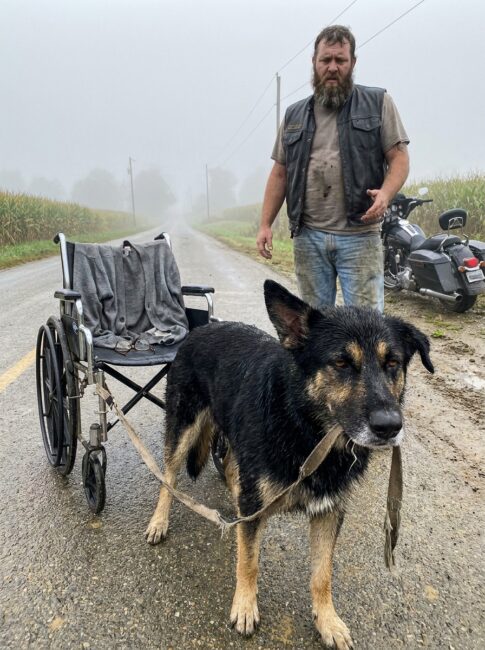
Marcus looked toward the road. The wheelchair stood at an angle above them, its bent front caster catching the gray morning light.
“Whatever his reasons were, he dragged that chair half a mile.”
Eli opened his eyes and looked at the dog.
“I noticed.”
The ambulance arrived twenty-one minutes after the call. Two paramedics stabilized Eli’s arm and prepared to carry him up the slope. The dog retreated when the stretcher appeared.
“He’ll run,” Eli said.
Marcus removed the belt from his leather vest and looped it loosely through a small circle of rope tied around the dog’s neck. He did not pull. The rope was old and worn, likely something the animal had acquired before meeting Eli.
The dog could slip free whenever he wanted.
Instead, he watched the paramedics lift the old man.
When they reached the road, Eli’s hand hung over the side of the stretcher. The dog walked beneath it, close enough that Eli’s fingers brushed his torn ear.
The animal startled.
Then he returned.
Eli touched the ear again.
Three years of distance ended beside an ambulance.
The paramedics could not transport an unrestrained dog. Marcus offered to follow with him, but the stray backed away from the motorcycle’s engine.
Eli looked toward Marcus.
“My house is the green one past the church. Foods in the metal bin.”
“I’ll take care of him.”
“He won’t come inside.”
“That makes two of us who don’t know what he’ll do.”
The ambulance left.
The dog ran behind it for almost a hundred yards before stopping. He stood in the center of the road, breathing hard, watching the red lights disappear.
Marcus rolled the damaged wheelchair toward his truck later that morning. The dog followed him to Eli’s house but remained outside the fence.
Food waited inside the metal bin exactly where Eli had said. Marcus filled the bowl and placed it near the porch.
The dog ignored it.
He lay beside the ramp, facing the road.
That afternoon, rain began falling.
The animal stayed.
At midnight, Marcus returned with a tarp and dry blanket. The food remained untouched.
“You saved him,” Marcus said. “You can eat now.”
The dog looked toward the empty road.
He was still waiting for Eli to come home.
Part 3 — Three Years of Almost Belonging
Eli Dawson had lived alone since his wife, Margaret, died eight years earlier. Their only son, Thomas, was killed in a construction accident two years before that. A framed photograph of both stood on the living-room mantel beside an old school-bus route map.
Eli’s legs had weakened after a spinal infection. He could stand briefly with support but relied on a manual wheelchair for daily movement. He refused assisted living, home aides, and most offers of help.
His nearest neighbor lived nearly a mile away.
The mail carrier saw him four mornings each week. A church volunteer delivered groceries on Fridays. If the accident had occurred after the weekend delivery, nobody might have noticed his absence until Monday.
The dog knew within seconds.
Marcus learned these details from Nora Bell, a sixty-five-year-old neighbor who drove him to Eli’s property after the hospital called. She recognized the stray beneath the porch.
“That’s Porch Dog,” she said.
“Porch Dog?”
“Nobody knows his name.”
She explained that residents had tried trapping him after he first appeared. Animal control left food inside a humane cage, but the dog never entered. A farmer approached with a rope and received a warning growl. Eventually, people stopped trying.
Only Eli continued feeding him.
“Eli says the dog isn’t his,” Nora said. “But he buys the expensive food because cheap food upsets the dog’s stomach.”
Marcus looked at the unopened bag inside the bin.
“He knows that?”
“He notices everything while pretending he notices nothing.”
The dog’s history remained uncertain. A faded groove around his neck suggested he had once worn a tight collar. He flinched at raised hands, truck doors, and the clatter of metal tools. Those reactions explained why he avoided Marcus’s fabrication shop when the damaged wheelchair was taken there.
Marcus owned Dalton Mobility and Metalworks, a small business that built ramps, handrails, wheelchair components, and vehicle adaptations. He began the work after his younger brother returned from military service with a spinal injury. Over twenty-seven years, the shop had repaired hundreds of chairs.
Eli’s model was old but salvageable. The right caster fork was bent, one brake cable had snapped, and the frame had twisted where it struck the ditch.
The dog had made the damage worse by dragging it.
Marcus did not care.
Those scratches where the reason Eli was alive.
He placed the wheelchair inside the open garage and worked with the doors raised. The dog watched from the gravel lot each evening but refused to cross the concrete threshold.
Marcus began leaving water outside.
The dog drank only after he stepped away.
It was the same arrangement he had maintained with Eli.
At the hospital, doctors confirmed Eli’s right forearm was broken in two places. He also had mild hypothermia and dehydration but no head injury. They expected him to remain for at least five days.
Marcus visited on the second evening.
Eli’s first question concerned the dog.
“He ate?”
“Not much.”
“Put a little chicken broth over the food.”
“You’ve been pretending that animal is a casual visitor for three years, but you know his preferred dinner.”
Eli adjusted the blanket across his knees.
“He stops by.”
“He dragged a wheelchair up a hill for you.”
“He’s stubborn.”
“So are you.”
Eli looked out the hospital window. “Did he go somewhere?”
“He sleeps beside your ramp.”
The old man’s fingers tightened around the edge of the blanket.
“He could leave.”
“He could.”
“Why doesn’t he?”
Marcus thought about the dog standing in the road after the ambulance disappeared.
“You already know.”
Eli did not answer.
On the fourth day, the hospital allowed a controlled visit outside. Marcus brought the dog in his pickup after spending forty minutes coaxing him onto a blanket in the truck bed.
Eli waited beneath the covered entrance in a hospital wheelchair.
The dog jumped down and stopped twenty feet away.
Neither moved.
Eli extended his uninjured hand.
“You again,” he said.
The dog approached slowly. He smelled the wheelchair, the hospital blanket, and Eli’s shoes. Then he placed his head beneath the old man’s hand.
Eli’s fingers rested behind the torn ear.
“I suppose you want breakfast.”
The dog closed his eyes.
A nurse standing near the entrance turned away to wipe her glasses.
Marcus remained quiet.
The dog had spent three years coming close enough to eat but never close enough to be held. Eli had spent eight years insisting that needing no one was safer than losing someone again.
At the hospital entrance, both surrendered one step.
Neither called it that.
Part 4 — The Chair He Dragged as Evidence
Marcus reconstructed the accident using the marks on the wheelchair and Eli’s account.
At approximately 7:10 the previous evening, Eli rolled toward the roadside mailbox. Heavy rain earlier that week had washed away gravel beneath the shoulder. When the right caster reached the soft edge, the ground collapsed.
The chair tipped.
Eli fell into the drainage ditch and struck his arm against the concrete culvert. The wheelchair rolled several yards downhill before becoming tangled in weeds.
The dog arrived while daylight remained. Eli heard him moving through the brush but could not see him clearly.
“I told him to go home,” Eli recalled.
“Which home?” Marcus asked.
Eli ignored that.
The dog entered the ditch and smelled Eli’s face. He pulled at the cardigan sleeve, trying to move him uphill. When Eli cried out, the dog released him.
For hours, the animal alternated between the old man and the road. He barked whenever a vehicle passed, but the ditch lay below the driver’s line of sight. Only two cars used the road that night, and neither stopped.
Shortly before dawn, the dog changed his strategy.
He climbed toward the wheelchair.
Eli heard metal moving through weeds. The dog apparently caught the safety strap and dragged the chair onto the road. Instead of returning it to Eli, he pulled it uphill toward the intersection where traffic was more likely.
“He couldn’t bring me to help,” Eli said. “So, he brought something of mine.”
The wheelchair was not merely an object.
It was evidence.
A barking stray might be ignored. A stray dragging an empty wheelchair could not be.
Marcus understood because the sight had forced him to stop before he knew a person was missing. The cardigan, glasses, and medicine pouch transformed the chair into a message.
Somebody belonged in this seat.
Somebody was not there.
The dog had created that message without training.
Hospital staff discussed the story with local news, but Eli refused interviews. He did not want his face on television and did not think anyone needed to know he had fallen while collecting mail.
Marcus respected the refusal.
The dog became more difficult to protect from attention. People drove past Eli’s house hoping to see him. Some approached with treats, phones, and children. The animal retreated beneath the porch.
Marcus placed a temporary sign near the driveway asking visitors to give him space. There was no plea for donations and no photograph.
The dog needed quiet more than admiration.
When Eli was discharged, the repaired wheelchair waited outside the hospital. Marcus had replaced the caster, brake cable, and damaged frame section. He also cleaned everything except one scratched area near the safety strap.
“Missed a spot,” Eli said.
“No.”
Marcus pointed to the marks left by the dog’s teeth.
“That stays.”
Eli ran his thumb across them.
The dog waited near Marcus’s truck. He approached the wheelchair cautiously, smelling each repaired component. When he reached the scratched strap, he placed it briefly between his teeth.
“You don’t have to pull it today,” Marcus said.
The dog released it.
At home, Eli rolled up the ramp and opened the front door. The animal stopped at the bottom.
For three years, that threshold had separated them. Food came outside. Eli went inside. The dog remained free to disappear before attachment became something had to acknowledge.
Eli turned his chair.
“You are coming?”
The dog sat.
Eli waited.
Ten minutes passed. Then twenty.
The October sun dropped behind the trees. Marcus leaned against his truck without speaking.
Finally, Eli rolled backward into the living room and left the door open.
The dog climbed the ramp.
He placed one front paw across the threshold, withdrew it, and looked toward the road. Then he entered far enough to smell Eli’s chair.
The old man lowered his hand.
The dog crossed the remaining distance and rested his chin on Eli’s knee.
“What do I call you now?” Eli whispered.
Marcus looked at the scratched wheelchair strap.
“Rider.”
The dog’s torn ear moved.
Eli repeated it.
“Rider.”
The stray had entered the house.
This time, the door remained open because he was no longer expected to leave