My name is Rachel Morgan. I was thirty-eight when the fire happened, and I worked as the librarian at an elementary school in Bartlett, Tennessee, just northeast of Memphis.
My husband, Mark, maintained commercial air-conditioning systems. Our son, Ben, was eleven. Our daughter, Lily, was eight.
Otis joined us on November 6, 2022.
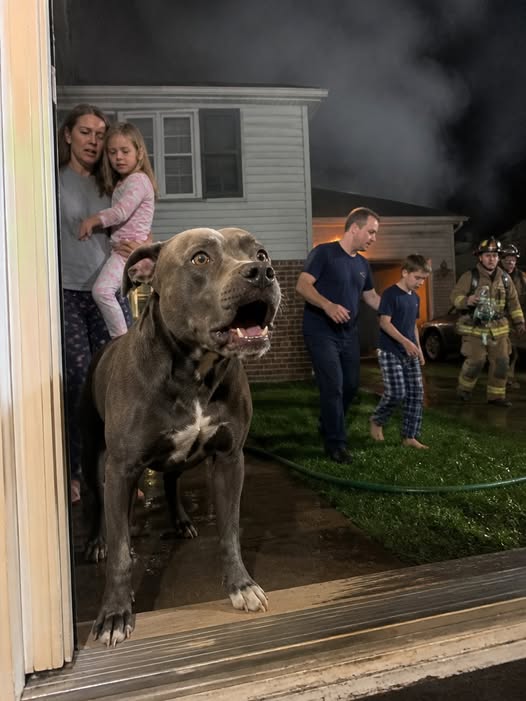
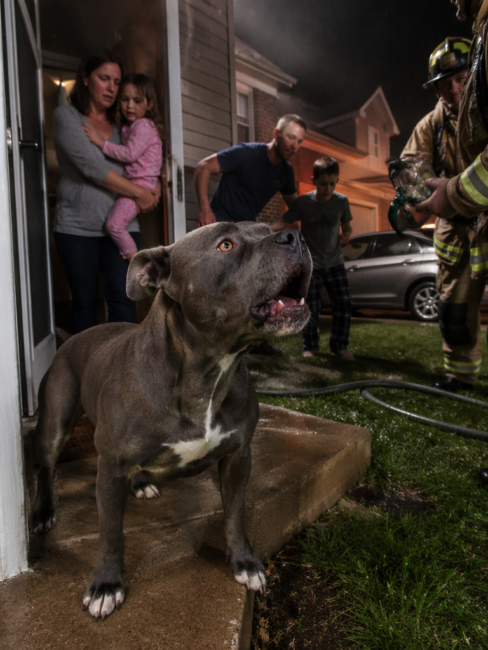
His shelter photograph showed a muscular Pit Bull mix sitting against a concrete wall. His coat was the color of storm clouds, except for a white crescent across his chest and four pale tips on his front toes. One ear folded neatly. The other carried a small notch along its edge.
The shelter described him as quiet.
That word concealed more than it explained.
Otis had been rescued from an unlicensed breeding operation with nineteen other dogs. Several neighbors had reported foul odors but claimed they rarely heard barking.
Investigators discovered why.
A veterinarian found scar tissue around Otis’s larynx consistent with an old devocalization procedure performed without proper follow-up care. The shelter did not know who had done it or whether pain control had been used.
The medical report contained careful language.
The scar beneath Otis’s jaw contained the rest.
Dr. Priya Shah told us he might produce soft breaths or a hoarse cough, but a normal bark was unlikely. Another surgery could worsen the narrowing in his airway.
“He can communicate,” she said. “You’ll have to learn his language.”
We did.
Otis tapped the back door twice when he needed to go outside. If his water bowl was empty, he sat beside it and touched the rim with one white toe.
When Ben forgot his backpack, Otis stood between him and the front door.
When Lily woke from a nightmare, Otis entered our room and pressed his cold nose against my wrist.
He never jumped onto beds. He rested his chin on the mattress and waited for permission.
His silence changed the way we watched him.
A dog’s bark often tells people where to look. Otis made us notice smaller things—the angle of his ears, the direction of his nose, the quick tightening of skin above his eyes.
He did not lack a voice.
His voice had become physical.
The first month, he slept beneath the kitchen table. By January, he moved to the hallway between the children’s rooms.
Every night, he followed the same route.
Ben’s door.
Lily’s door.
The top of the stairs.
Then the hallway rug.
We considered it a guarding habit.
At 1:00 or 2:00 in the morning, I sometimes found him sitting beneath Lily’s doorknob, listening. If she coughed, his head tilted. If her breathing remained even, he returned to the rug.
Lily’s asthma made him alert to changes in her breath. During treatments, he lay beside the nebulizer and watched the mist rise through the mask.
He also reacted to smoke.
Burned toast brought him into the kitchen before the detector sounded. The first time Mark lit the fireplace, Otis stood beneath the ceiling vent and refused to lie down until the flue opened fully.
One evening, bacon grease smoked inside the oven.
Otis ran from the kitchen to each bedroom.
His mouth opened.
Only air came out.
We laughed gently and called him our silent fire inspector.
That was the first detail we misunderstood.
The second happened whenever Lily hid during storms.
Otis always found her.
Part 3 — The Quiet Things We Stopped Questioning
Lily began hiding in the laundry room after a tornado warning the previous spring.
Our neighborhood sirens sounded at 10:38 one evening. Lily covered her ears and crawled behind a basket of towels while we were gathering flashlights.
Otis found her before any of us noticed she had left the hallway.
He entered the laundry room, pushed the basket aside, and touched her knee with his nose. Then he returned to me and pressed his head against my hand.
I followed him.
After that, thunderstorms created a new routine.
When thunder shook the windows, Lily went downstairs with Otis. She sat behind the towels while he lay across the doorway. Mark and I tried to redirect her to the interior bathroom, which was safer during severe weather.
Lily understood the safety plan during daylight.
Fear changed the plan.
Otis understood both versions.
He learned the hiding place she chose and the place she was supposed to choose.
During the following year, our family changed in ordinary ways.
Ben started middle school and became embarrassed when I kissed his forehead near the bus stop. Otis waited behind the hedge, where Ben could touch his back without classmates noticing.
Mark switched companies and worked longer shifts. Otis began carrying one of his work gloves from the mudroom whenever the truck turned into our driveway.
I returned to school after summer break. Otis followed me from room to room while I gathered library books, sitting on every open box as if he objected to August.
Lily learned to use her inhaler without help. She practiced beside Otis because his breathing gave her a slow rhythm to copy.
“Breathe with me,” she told him.
Otis watched her face.
His own breathing was not always easy. Scar tissue narrowed his airway, especially during humid weather or heavy exercise. Dr. Shah advised us to use a harness instead of attaching a leash to his collar.
He never ran for long.
Still, he checked every room before sleeping.
We installed a small hallway camera after Lily began sleepwalking. The device recorded motion but uploaded only short clips. Most showed Otis passing beneath it at night.
1:14 a.m.—Otis checks Ben’s door.
1:17 a.m.—Otis enters Lily’s room.
1:19 a.m.—Otis rests at top of stairs.
The recordings seemed repetitive, so I stopped reviewing them.
Otis continued.
During the autumn before the fire, contractors renovated our upstairs bathroom. Dust triggered Lily’s asthma, so we stayed with my sister for three nights.
An electrician disconnected part of the hardwired smoke-alarm circuit while moving a ceiling light. He restored power before leaving.
At least, we believed he did.
The smoke alarms flashed when tested from the downstairs panel. We did not know their backup batteries had been removed during the work and never replaced. We also did not know one connector inside the attic remained loose.
The system appeared functional.
A month later, Mark pressed the test button on the hallway alarm. It sounded.
We trusted it.
Otis did not understand electrical wiring. What he understood was air.
When the furnace started, he lifted his nose toward the vents. When we ran the clothes dryer, he inspected the laundry-room door. If Mark used solvent in the garage, Otis remained inside the kitchen until the smell disappeared.
On February 16, the garage freezer began making a clicking sound.
Mark planned to inspect it that weekend.
At 9:40 that night, he unplugged a power strip near the workbench but left the freezer connected. The compressor stopped clicking.
We went to bed.
Otis completed his usual route.
He checked Ben.
He checked Lily.
He stood at the top of the stairs.
At 1:58, the hallway camera recorded him lifting his head.
He remained still for fourteen seconds.
Then he walked downstairs.
At 2:04, he returned and entered our bedroom. He pressed his nose against my hand, but I turned over without waking.
At 2:07, he visited Ben.
At 2:09, he entered Lily’s room.
At 2:10, Lily followed him into the hallway.
She thought Otis needed help.
The dog went downstairs.
Lily followed.
At 2:11, smoke entered the camera frame.
Otis turned and saw her behind him.
He pushed her toward the staircase, but a loud crack from the garage frightened her into the laundry room.
Otis ran upstairs.
He struck our door with his shoulder.
We remained asleep.
At 2:17, he forced air through a throat someone had damaged to keep him quiet.
The bark reached us.
The smoke alarms did not.
Part 4 — The Night His Silence Broke
The fire began where the freezer cord entered an old wall outlet.
Investigators later found heat damage inside the receptacle and a line of burned insulation behind the garage workbench. Flames traveled upward into the wall before spreading across stored cardboard boxes.
Smoke entered the house through a return-air vent.
Otis detected it before any sensor responded.
By the time his bark woke us, the staircase had become the dividing line between safety and the fire.
Mark reached Ben first.
Our son came awake coughing and confused. Mark wrapped a blanket around his shoulders and pushed him toward the rear bedroom.
I ran to Lily’s room.
Her night-light shone through a layer of gray smoke. Her stuffed rabbit lay near the doorway. The plastic cup from her nightstand had rolled into the hall.
The bed was empty.
“Lily!”
Otis entered the room, checked beneath the bed, and turned toward the stairs.
I caught his harness.
“No.”
He pulled once.
His eyes remained fixed on the lower floor.
Then I remembered the laundry room.
Otis twisted free before I could stop him.
He moved down the stairs with his chest close to the steps. Smoke swallowed his back, then the white crescent on his chest, then the tip of his tail.
I followed.
Three steps below the landing, heat struck my face. My lungs closed around the first breath. Mark pulled me backward by the waist.
“She’s down there.”
“Fire department is coming.”
“She has asthma.”
“I know.”
The rear window became our only exit. Mark broke the screen and shouted to the neighbor outside. A ladder struck the roof below us.
Ben climbed out.
I stayed beside the bedroom door, watching the stairs.
Seconds stretched.
A firefighter later told me Otis was downstairs for less than two minutes.
Inside that hallway, it felt longer than the life we had already shared.
Then his head appeared.
Otis climbed one step at a time, pulling Lily by her pajama sleeve. She crawled behind him. One hand held his harness while the other covered her mouth.
He stopped twice.
Each time, Lily pushed from behind, and Otis continued.
When they reached the landing, I grabbed Lily beneath her arms. Mark lifted Otis.
The dog’s legs folded against his chest.
Outside, wet grass pressed through my pajama pants as I knelt beside him. Firefighters fitted a pet oxygen mask over his muzzle. His eyes remained open, but his breathing came in shallow pulls.
Lily sat inside the ambulance with a nebulizer mask over her face.
She pointed at Otis.
“Take him too.”
Paramedics could not transport an animal in the ambulance, so our neighbor drove Otis to the emergency veterinary hospital while Mark accompanied Lily.
I stayed with Ben on the sidewalk as flames moved behind the upstairs windows.
Our house burned for another forty minutes.
Everyone survived.
That seemed like the ending.
Then Dr. Shah called from the animal hospital.
Otis’s lungs were responding to oxygen, but swelling had narrowed his already damaged airway. The veterinarian needed permission to place a breathing tube.
“Will he live?”
“We’re working on that.”
“Will he bark again?”
Dr. Shah paused.
“Rachel, the sound he made may be the only bark his throat was capable of producing.”
I gave permission.
Otis entered surgery at 4:06.
Before the anesthetic took effect, he lifted one white paw and tapped the metal table twice.
The signal he used for a door.
The staff did not understand.
I did.
He wanted to go home.
There was no home left.