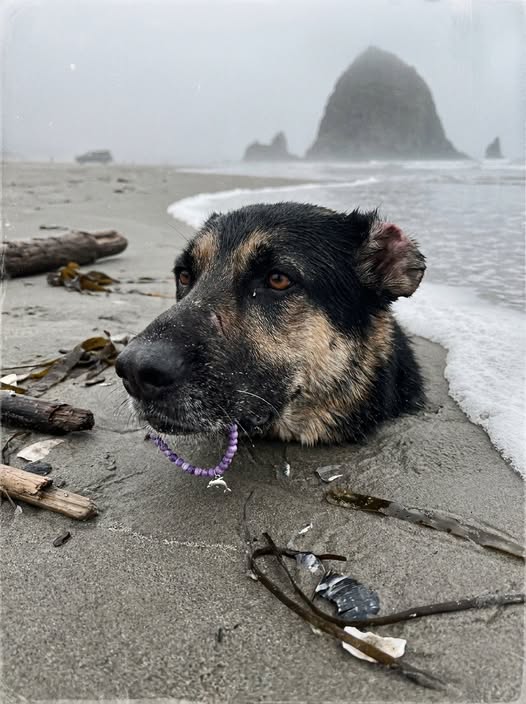
Part 2
The missing girl’s name was Madison Reed, but her family called her Maddie.
Her father, Ethan, was a white American high school history teacher from Portland. Her mother, Sarah, was a white American pediatric dental assistant with tired eyes and a voice that kept breaking on the same sentence: “She was right there.” They had come to Cannon Beach for three nights because Maddie loved tide pools and had saved ten dollars in tooth fairy money for saltwater taffy.
A family trip.
A beach rental.
A child’s purple jacket hanging on a kitchen chair.
That was how ordinary the beginning looked.
The Reeds had eaten dinner at a small place near Hemlock Street. They came back after sunset, carrying leftovers, wet shoes, and a sleepy little girl wrapped in a towel because she had insisted on one last look at the water. Ethan put her on the couch while Sarah took bags upstairs. Her grandmother called. A smoke alarm chirped. Someone opened the back door to shake sand from a blanket.
Then Maddie was gone.
Not for long, at first.
That is how panic begins. It gives you a tiny explanation before it takes everything. Maybe she went to the bathroom. Maybe she hid behind the curtains. Maybe she went onto the porch. Maybe she followed the cat that had been prowling near the dunes.
Then came the sandal.
Then the open gate.
Then the empty beach.
By midnight, volunteers were moving in lines with flashlights. A K9 unit came from Seaside. Coast Guard was notified because tides had turned rough. We checked beach rentals, parking lots, public restrooms, crawl spaces under decks, dunes, alleys, and the rocks where children liked to climb even after signs told them not to.
No bracelet was mentioned at first.
That mattered later.
Her mother had made it with her that afternoon at a beach craft shop. Purple beads. white letters. a plastic dolphin charm. Maddie had refused to take it off, even in the bath. In the first hours of the search, Sarah forgot the bracelet existed because fear does not make a neat inventory. It grabs the largest missing thing and blinds you to the rest.
The dog changed that.
I did not know his name, so I called him Tide in my head.
It was not official. It was not even clever. But when a dog is buried where the ocean can reach him, you give him something stronger than “unknown.” Tide’s body trembled when I dug him free. His front legs buckled. His fur hung in wet ropes against his ribs. Sand poured from the hollow where his body had been packed.
He still would not drop the bracelet.
Officer Luis Ortega arrived first, a Latino American officer in his late thirties, broad-shouldered and calm under pressure. He knelt beside me, saw the purple beads, and went still.
“Is that—”
“Yes.”
I did not finish because the dog tried to stand.
His back legs shook.
His front paws spread wide on the sand.
I expected him to collapse into my arms. Instead, he turned north toward the basalt rocks and pulled against my hand.
Not hard.
Enough.
Tide had been buried below the tide line.
He had held a child’s bracelet in his mouth.
Now he wanted to move.
That was the second seed.
A dog recovering from that kind of fear should seek warmth, water, or escape. Tide sought direction. He took three steps, stopped, looked back at us, and whined.
Luis looked at me.
I looked at the rocks.
The ocean hissed behind us, filling the hole where Tide had almost disappeared.
“Call search command,” I said.
Then I followed the dog.
Part 3
The false climax was the moment we found Maddie’s jacket.
Tide led us along the edge of the beach where wet sand gave way to rock and tide pools. He moved slowly, coughing saltwater now and then, but his nose stayed low and his ears worked like small antennas. Every twenty feet, he stopped, looked back, and waited for us to catch up.
We had searchers nearby within minutes.
Two officers.
Three volunteers.
A firefighter.
Then more.
Nobody crowded Tide. Somehow everyone understood that he was not a mascot in that moment. He was not a headline. He was working from a map no human could see.
The rocks north of Cannon Beach are not gentle.
They rise in black shelves and slick ledges, with pockets where water gathers and caves that appear or vanish depending on tide and fog. Tourists photograph them in summer. Locals respect them more in winter. That morning, the tide had not swallowed the lower coves yet, but it had started making promises.
Tide climbed like pain had become a language he refused to speak.
Once, his leg slipped.
I reached for him.
He steadied himself and kept moving.
About half a mile from where we found him, he stopped near a pile of driftwood jammed between two rocks. A purple scrap of fabric fluttered from a branch, wet and twisted.
Maddie’s jacket.
Her mother had described it again and again: purple rain jacket, white zipper, small daisy patch on the sleeve. The sleeve hung there like the beach itself had decided to give us one piece back.
Luis called it in.
My throat tightened.
Tide sniffed the jacket, then moved past it.
That is when hope becomes dangerous. It lifts its head before you know whether it has legs. Every person there felt it. You could hear it in the change of breath. The volunteers stopped looking at the ground and started looking ahead.
“Tide,” I said, though he did not know the name yet.
He paused.
His head turned toward a narrow gap between the rocks, half hidden by kelp and shadow.
A child could fit there.
An adult could, if he knew it existed.
We moved closer.
A sound came from inside.
Not the ocean.
Not gulls.
A small cough.
Luis raised his hand, and everyone froze.
“Maddie?” I called.
Silence.
Then, weak and thin:
“Mom?”
The world shrank to that one word.
The firefighter squeezed through first. I followed low, scraping my shoulder on stone. The space opened into a shallow sea cave, not large, but deep enough that a child could be hidden behind a curve in the rock. Maddie sat on a sand shelf above the waterline, wrapped in a torn beach towel, shivering, scared, alive.
Alive.
That should have been the end.
For a few minutes, it felt like it was.
We carried her out with careful hands. She clutched my sleeve until she saw the open beach. Then she saw Tide standing outside the rocks, water dripping from his muzzle, bracelet still between his teeth.
Her face changed.
“Doggy,” she whispered.
Tide dropped the bracelet into the sand at her feet and sat down.
Searchers cried quietly. Luis looked away. The firefighter said something into his radio that sounded professional until his voice broke.
We had found the child.
The dog had led us.
A rescue story, complete enough for people to understand.
Then Maddie pointed at Tide and said, “He bit the bracelet when the man tried to pull me away.”
The beach went silent again.
Part 4
The story turned darker, but not louder.
That is how the truth arrived.
Maddie was treated by paramedics on the beach, wrapped in blankets, checked for injuries, given careful questions and time. Her parents were brought to her once medics cleared the moment. Sarah Reed fell to her knees in the sand and held her daughter without words. Ethan stood behind them with both hands over his mouth, his face emptied by relief and the knowledge of how close the tide had come to writing a different ending.
Tide watched from beside me.
He did not push toward the family.
He did not behave like a pet greeting his owner.
That was the first twist after the rescue.
Maddie knew him only as “the beach dog.”
Not her dog.
Not a family dog.
A stray.
She had seen him earlier that afternoon near the tide pools, where he had followed her at a distance while she collected shells. She had given him one piece of turkey from her sandwich when her mother was not looking. He had wagged his tail once, then followed the family partway back to their rental before disappearing near the dunes.
The man who took Maddie had not expected the dog.
Maddie told the child specialist later that when the man grabbed her near the back gate, Tide came from behind the dune barking. He bit at the man’s sleeve. He snapped at the purple bracelet because Maddie had her arm raised, reaching back toward the house. The bracelet broke loose.
Tide held it.
That was the second twist.
He had not found the bracelet after the fact.
He took it during the struggle and kept it.
The man dragged Maddie toward the rocks, away from the lit houses and search lines. Tide followed. Barking. lunging. retreating when kicked at, then coming again. Near the cave, the man forced Maddie inside and blocked part of the entrance with driftwood. Tide stayed outside, making noise until the man came back for him.
That was why Tide had been buried.
Not punishment only.
Prevention.
The man understood the dog would lead someone to the cave if he remained free.
The thought made my hands go cold in my gloves.
No one needed to say what almost happened. The tide did enough speaking. The place where Tide had been buried was already underwater by the time we returned to photograph it. Only foam turned over the sand, as if the ocean had been invited to cover a crime and had arrived on schedule.
The third twist came from the duct tape on Tide’s collar.
I had noticed it while digging him out. Silver tape twisted through the buckle, no tag beneath it. At first, I thought someone had tried to remove a name. The crime scene tech peeled it carefully and found a piece of fishing line caught under the collar, tied to a tiny brass bell.
A bell.
Maddie recognized it.
“He had that before,” she said later. “The man made it stop.”
The bell had likely been on Tide so locals could hear him near the beach cafes, where he begged without bothering people. The man had taped it silent before burying him. One more small choice. One more proof that the dog had been seen as a threat.
We released photos of the jacket, the area, the vehicle description from security cameras, and later that afternoon a ranger spotted a man returning near the north access trail. He was arrested without incident after officers matched his vehicle to footage near the rental houses.
I will not give his name here.
He has had enough attention from court records.
This is not his story.
This is Tide’s.
The dog with sand in his eyes.
The dog who held a bracelet until his jaw trembled.
The dog who could have run when the child was hidden, but stayed close enough to be caught because leaving her was not in him.
That night, while Maddie slept at the hospital with her mother curled beside the bed, Tide slept in a kennel at the emergency vet. He had bruised ribs, salt irritation, raw patches from packed sand, and exhaustion deep enough that the vet said he might sleep for a full day.
Before leaving, I placed the purple bracelet in an evidence bag.
Tide lifted his head.
His eyes followed it.
“Not lost,” I told him.
He put his head back down.
For the first time all day, he let sleep take him.