Part 2 — Rising Action
Before Ranger died, I believed partnership was built through training.
Commands.
Repetition.
Reward.
Correction.
Hours on the field until the dog’s body understood what your voice meant before your mouth finished saying it.
Ranger taught me that training was only the surface.
The real partnership lived underneath.
It lived in the way he shifted his weight when he sensed my change. It lived in the small grunt he made when I took too long putting on my boots. It lived in the silence between calls, when the cruiser rolled through Nashville at 3 a.m. and the city looked like a thing holding its breath.
I met Ranger when he was fourteen months old.
He came from a working line in Kentucky, all legs, teeth, and suspicion. He did not like me at first. He liked my left boot. He liked the tug toy. He liked the back seat of the cruiser. Me, he considered optional.
On our first week together, he ignored a basic recall in front of three senior handlers and chased a paper bag across the training yard. Miller laughed so hard he had to sit on a bumper.
“Good luck, Hale,” he said.
I nearly gave up then.
Ranger did not.
That was the first strange thing about him. He was difficult, but never lazy. He wanted to work. He simply wanted proof I was worth working with.
So, I showed up.
Every morning.
Rain.
Heat.
Long shifts.
Bad calls.
Divorce papers.
My father’s stroke.
The night my brother called from Memphis and said, “Mom’s gone.”
Ranger was there through all of it.
When my marriage ended, he slept across my apartment door for six weeks, as if heartbreak might try to leave and he needed to block it. When my father moved into assisted living, Ranger rode with me every Sunday, sitting upright in the back seat while Dad fed him contraband bacon under the table.
When we found the missing boy in Shelby Park after eleven hours, Ranger lay down beside the child and refused to leave until the paramedics arrived. The boy’s mother tried to thank me. I pointed at the dog. She knelt in the mud and kissed Ranger between the ears.
He looked offended.
He loved it.
There were bad days too.
A suspect with a knife in an alley off Dickerson Pike.
A domestic call where a little girl hid in a laundry room and Ranger stayed outside the door until she came out.
A warehouse search where the power failed, and Ranger guided me through darkness by the tension in the leash.
He was not a pet in the easy sense.
He was my partner.
My alarm clock.
My shadow.
My excuse to go home.
The department saw the stats.
I saw the rest.
How he carried my sock to the front door when he wanted a walk.
How he leaned into the cruiser window on hot days to smell rain coming.
How he placed one paw on my knee after hard calls, not asking to be petted, just pinning me to the world.
The second seed was the orange training ball.
Ranger loved it in a way that bordered on religion. Most K9s love reward toys, but Ranger treated that ball like it had a badge number. It lived in my locker, then in the cruiser, then sometimes under my couch because he had stolen it.
After he died, I could not find it.
I thought someone at the unit had packed it away.
I did not ask.
Grief makes cowards of practical men.
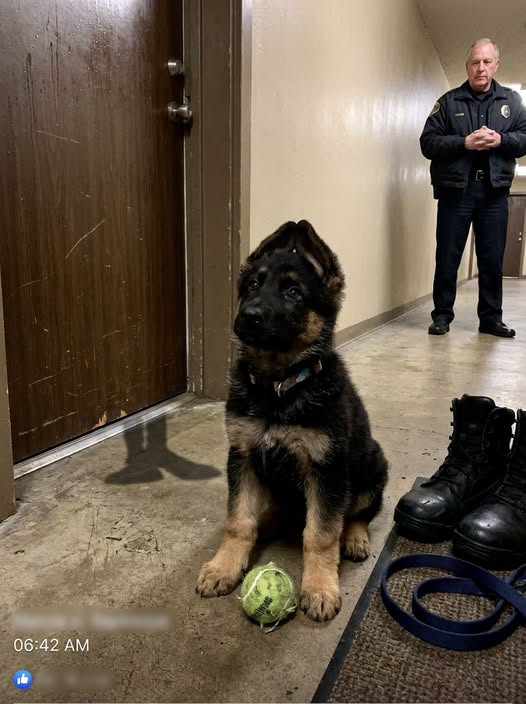
When Rookie began appearing at my door with an orange ball in his mouth, I told myself every K9 puppy had one.
That was true.
But not the whole truth.
His ball had a small black mark near the seam.
So did Ranger’s.
I noticed it on day four and shut my eyes so hard the hallway blurred.
Because some details feel like invitations.
And I was not ready to be invited anywhere.
Part 3 — False Climax
Ranger died on a Thursday, though paperwork says Friday because the hospital kept his heart going past midnight.
I know the truth by the light.
Thursday had cold blue light.
Friday came with rain.
We were called to an old warehouse near the Cumberland River after reports of a burglary crew stripping copper. The building had been condemned for years. Broken windows. Sagging floors. Chemical drums left behind by people who did not want permits or questions.
It should have been routine.
Routine is a word officers use to lie to themselves.
Ranger found the first suspect hiding behind a stack of pallets. Clean work. No bite. No injury. The man surrendered when he heard Ranger’s warning bark and saw the black shape beside me in the flashlight beam.
Then the floor above us shifted.
A second suspect ran across a catwalk.
Boards cracked.
Metal screamed.
I remember shouting.
I remember Ranger lunging forward.
I remember the catwalk giving way.
The suspect fell hard but lived. Ranger took the impact of debris that should have hit me. A beam struck his shoulder and side. He still tried to stand when I reached him.
That is the image that does not leave.
Not the blood.
Not the noise.
His eyes.
Angry.
As if his own body had disobeyed him.
I rode in the back of the emergency vet vehicle with one hand on his neck, saying his name every few seconds because I was afraid, he might follow silence somewhere I could not go.
“Stay with me.”
“Ranger.”
“Stay.”
He listened for eight years.
That night, he tried.
The surgeon came out at 1:42 a.m. with eyes that had already apologized before his mouth opened.
Internal injuries.
Too much damage.
He did not suffer long.
People say that like it helps.
Maybe sometimes it does.
It did not help me.
The department held a memorial three days later. Officers lined the street. The K9 unit stood in formation. A folded flag. A framed photo. Ranger’s badge. His leash placed across an empty kennel.
Miller spoke.
I heard none of it.
I stood with Ranger’s collar in both hands and looked at the place where he should have been sitting, bored by ceremony, scanning the crowd for someone holding food.
Afterward, people touched my shoulder.
Said the things people say.
“He was a good dog.”
“He saved lives.”
“He died a hero.”
I nodded because my body knew how.
Inside, something had gone very still.
Two weeks later, I told Miller I was done.
“K9 or the job?” he asked.
“Both.”
He took the resignation letter and did not read it.
“You’re on leave.”
“I said done.”
“I heard you.”
That was our false ending.
Ranger was gone.
I was broken.
The department would move on.
I would become another former officer with a box of awards in a closet and a dog bowl I could not throw away.
Then Miller brought Rookie to my door.
And the story refused to stay buried.
Part 4 — The Twist
The first twist was that Rookie had not been assigned to me.
Not officially.
Miller admitted it only after I opened the door on the fourteenth morning and found the puppy sitting alone with Ranger’s old tennis ball.
I stood there in sweatpants, barefoot, unshaven, holding a resignation letter in one hand and the doorframe with the other.
Rookie looked up, tail thumping once.
The tennis ball sat between his paws.
Not the orange training ball.
Ranger’s old green one from my apartment.
The one with a split down one side.
The one that had vanished after the memorial.
I crouched without meaning to.
“Where did you get that?”
Rookie picked it up and stepped forward.
Then he pressed it into my palm.
Not dropped.
Pressed.
As if returning evidence.
I looked down the hallway. Miller stood by the stairs, arms folded, face careful.
“You came in my apartment?”
“No.”
“Then how did he get this?”
Miller sighed.
“Ranger had a stash.”
I stared at him.
“What?”
“At the unit. Under the old kennel platform. Toys, socks, one of your gloves, half a leash, that ball. We found it after the memorial.”
My chest tightened.
Ranger had hidden things his whole life. Socks behind the couch. Toys under cruiser mats. Once, my radio mic in his bedding because I had ignored him during a long report.
“But how did Rookie—”
“He found the stash during kennel orientation,” Miller said. “Wouldn’t leave it alone. Pulled that ball out first.”
Rookie wagged.
I looked at the puppy.
He had no idea what memory was.
Or maybe dogs have their own version.
The second twist came when Miller told me Rookie had been refusing other handlers.
Not aggressively.
Worse.
Politely.
He trained. He listened. He learned. But whenever they brought him near the K9 wing, he pulled toward Ranger’s old kennel. Whenever they walked past the parking lot, he pulled toward my assigned cruiser. Whenever Miller loaded him in the truck, Rookie sat facing the direction of my apartment.
“That’s why I brought him,” Miller said.
“So he did pick my door.”
“In his way.”
I hated how that sounded.
Because it made the puppy less like a replacement and more like a question Ranger had somehow left behind.
The third twist came from Ranger’s final evaluation file.
Miller brought it a week later, after I let Rookie inside for the first time and spent twenty minutes pretending I was only doing it because the puppy was wet.
Inside the folder were reports, certifications, deployment notes, veterinary records.
And a page I had never seen.
Written by Miller.
Recommendation: future training mentor assignment for Officer Hale after Ranger retirement.
My name.
Before the warehouse.
Before death.
Miller had planned to move me into mentoring younger K9s when Ranger retired. Not because I was finished on the street, but because Ranger had made me good at reading dogs that other handlers called difficult.
Below that, in Ranger’s retirement transition notes, someone had written:
Potential puppy candidate: male GSD, high persistence, strong handler attachment, responds to calm grief states.
Rookie.
He had been chosen before Ranger died.
Not to replace him.
To follow him.
I sat at my kitchen table with that page in my hands, Rookie asleep under my chair, one oversized paw resting on my boot.
Miller said, “Ranger was supposed to meet him.”
I looked up.
“What?”
“We planned a short overlap. Let the old dog help shape the pup. Happens sometimes. Good senior K9s teach manners faster than humans do.”
The room tilted.
Ranger was supposed to meet Rookie.
The old partner was meant to show the new one the way.
Instead, Rookie had inherited a door closed by grief.
And still, every morning, he came back.