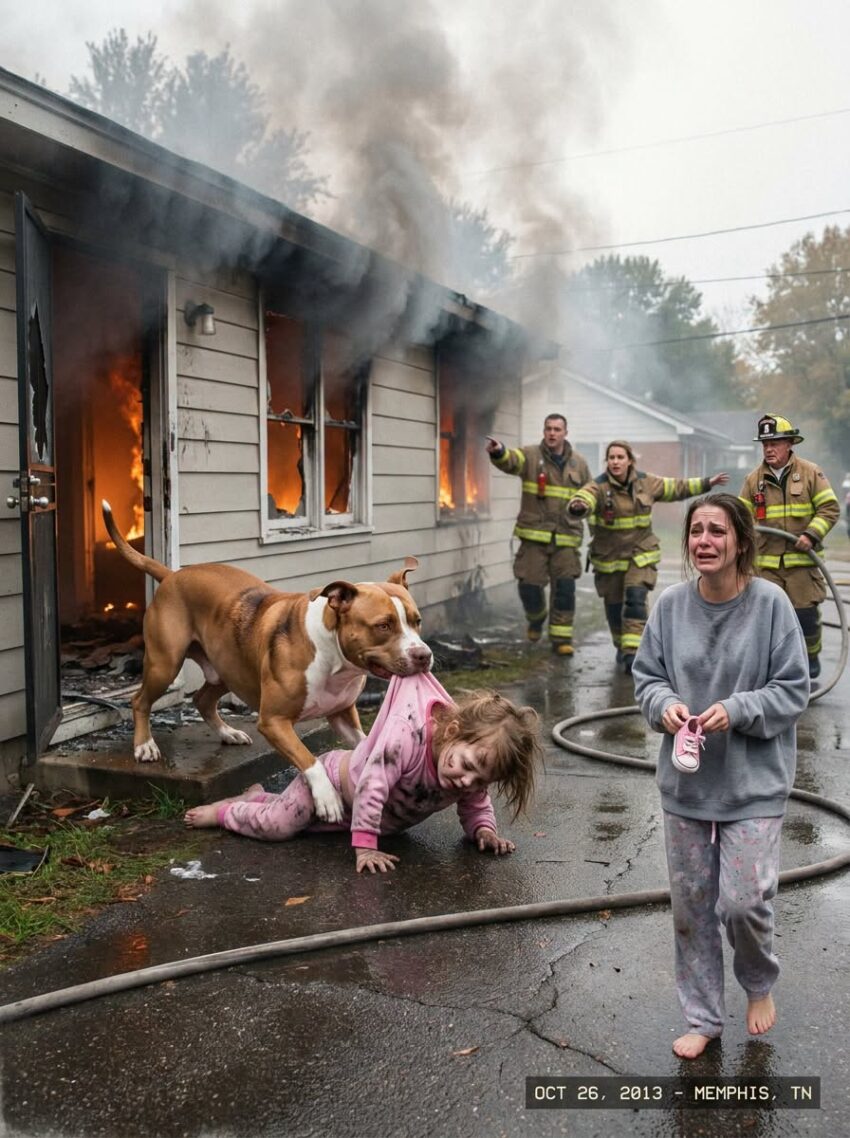
Before the fire, Mabel was the kind of dog people crossed the street to avoid.
Not because she had ever hurt anyone. She never had. But she was a Pit Bull in a neighborhood where fear traveled faster than facts, and some people only needed to see her square head and strong shoulders to decide what kind of story she belonged in.
Caleb brought her home three years before he died. He found her behind Station 18 after a thunderstorm, wet, thin, and guarding a cardboard box full of nothing but towels. He called me from the truck bay and said, “Nora, don’t get mad yet.”
That was how most of our trouble started.
I was six months pregnant with Lily, tired all the time, and not looking for a rescue dog with scars on her legs and eyes that watched every doorway. But Caleb knelt beside her in our kitchen and held out a piece of turkey, waiting twenty minutes until she took it from his palm without shaking.
“She’s not broken,” he said. “She’s listening for the part of the world that won’t hurt her.”
That was Caleb. He talked about scared things like they were people who had lost their address.
Mabel became his shadow first.
She slept beside his boots. She waited at the window when his shift ran late. When he came home smelling like smoke, rain, and metal, she pressed her nose into his jacket as if checking him for missing pieces.
When Lily was born, I worried Mabel would be jealous. Instead, she spent the first week lying outside the nursery door, one ear up, one ear folded, like a small guard who had not yet been given permission to enter the palace.
The first time Lily cried hard, Mabel brought Caleb’s sock and dropped it beside the crib.
Not a toy.
A solution.
Caleb laughed so loudly he woke the baby again.
“She thinks my feet fix things,” he said.
As Lily grew, Mabel became part babysitter, part pillow, and part silent alarm. If Lily crawled too close to the porch steps, Mabel blocked her with her body. If Lily reached for a hot mug, Mabel nudged her wrist away. If Lily hid during a thunderstorm, Mabel found her before I did.
That last part seemed small then.
It was not.
Lily’s hiding started after Caleb’s funeral.
At first, she hid behind the couch when neighbors came with casseroles. Then under the dining table when someone mentioned her father’s name. By the time she turned four, she had claimed the closet beneath the stairs as her safe place.
I hated that closet.
It smelled like dust and old winter coats. There was barely room for a child to sit with her knees pulled up, but Lily loved it because Caleb had once played flashlight games with her there during a power outage. After he died, she taped his photograph to the inside wall, right above the small wooden stool where she sat with her stuffed rabbits.
Mabel knew.
Of course she knew.
Every time Lily vanished, Mabel would stand outside that closet and thump her tail once against the floor.
One knock.
Then she would wait.
Not scratching. Not whining. Just waiting until Lily opened the door and wrapped both arms around her neck.
I should have noticed the pattern.
I should have noticed how Mabel always checked the closet first.
There were other things too.
Little things that looked like habits but were really warnings wearing ordinary clothes.
Mabel hated the old dryer vent in the laundry room. She would sniff it, sneeze, and back away. She refused to sleep in the hallway after Caleb died, choosing instead to lie between Lily’s bedroom and the kitchen. Once, in January, she barked at the smoke alarm before it chirped, staring at the ceiling until I replaced the battery.
I told people she was dramatic.
Caleb would have called her observant.
After he died in a warehouse collapse, I changed in ways I did not want to admit. I stopped cooking real dinners. I forgot bills. I let laundry sit until it smelled sour. I sold Caleb’s truck because seeing it in the driveway felt like getting the news twice every morning.
And one night, after Mabel knocked over a stack of folded clothes while chasing Lily through the hallway, I shouted, “I can’t do this with you too.”
Mabel went still.
Lily cried harder than the dog did.
Two weeks later, I filled out an online form for a rescue placement.
I never submitted it.
But I filled it out.
That is a fact I carried like a stone after the fire.
Because on the morning our house burned, the dog I thought might be too much for me became the only one who knew where my child had gone.