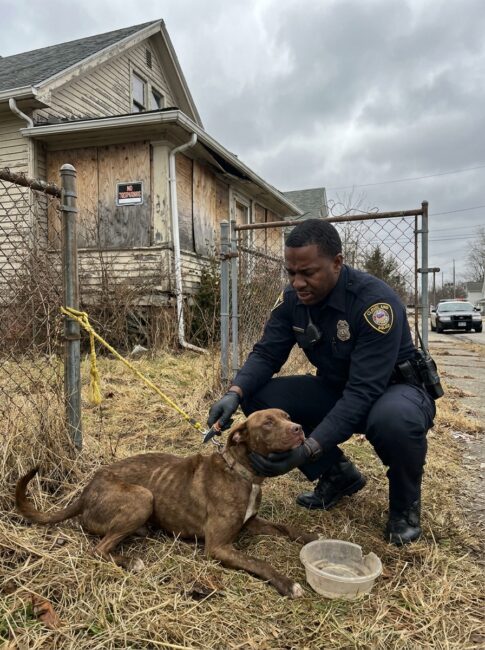
Part 2 — The Ride to Maple Heights Animal Hospital
Animal control was twenty minutes out, maybe longer, and the did not have twenty minutes of waiting in the weeds just to make my paperwork cleaner. I wrapped him in the emergency blanket from my cruiser and carried him to the back seat because lifting him into my arms felt like picking up a question the whole city had failed to answer.Dogs
He weighed almost nothing.That is not a figure of speech. The dog was medium-sized by bone structure, maybe meant to be fifty pounds, but he felt closer to twenty-five. His shoulder blades pressed through the blanket. His ribs shifted beneath my forearm. Every breath seemed to take planning. I had carried injured people before, children after crashes, intoxicated men who fought me, elderly women after falls, but there was something uniquely unbearable about carrying a dog who did not resist because he had no strength left to choose anything else.Patio, Lawn & Garden
I radioed dispatch and told them I was transporting an animal in critical condition to Maple Heights Animal Hospital. There was a pause, the kind dispatchers use when they are deciding whether to remind you of procedure or simply let the humanity in the room win.
“No,” I said, looking in the rearview mirror as the dog’s eyes drifted shut. “I need him to make it.”
The clinic was twelve minutes away if I obeyed every light. I did not obey every light. I did not run full emergency because scaring a half-dead dog with sirens felt cruel, but I used the kind of careful urgency officers understand and traffic mostly forgives when a cruiser moves with purpose. In the back seat, the dog lay under the silver blanket with his nose pointed toward the window. When I stopped at a light, he opened his eyes and looked at me in the mirror.
I have never believed dogs think in sentences the way people do.
But I know when an animal is asking whether the next place will be worse.
“It’s a hospital,” I told him. “Good people. Warm room. Food, but not too much yet. You hear me? You’ve got to stay with me.”
At Maple Heights, a vet tech named Julia Crane, a white American woman in her late twenties with red hair and a blue scrub top covered in paw prints, met me at the entrance with a gurney. Behind her came Dr. Samir Patel, a forty-two-year-old Indian American veterinarian with calm brown eyes, a trimmed beard, and the ability to make urgency sound quiet.
“How long tied?” he asked.
“Unknown. Found behind a vacant property. No food, no water. Severe emaciation.”
Dr. Patel lifted the blanket and inhaled sharply, not from smell, but from the sight of him. That reaction told me everything I feared.
They moved fast. Temperature. Bloodwork. IV access. Glucose. Small amounts of warm fluids. Flea treatment delayed until stable. Photos of pressure marks. Gentle exam of the collar area. He had sores where the nylon rubbed. His gums were pale. His dehydration was bad. His blood sugar was low. Dr. Patel said the most dangerous thing now was not only starvation itself, but the possibility of refeeding syndrome, a condition where food given too quickly can hurt a body that has been deprived too long.
That felt unfair in a way that made me angry.
Even food had to be careful.
“What are his chances?” I asked.
Dr. Patel did not lie. Good doctors do not.
“Guarded. But he’s responsive. That matters.”
Julia had a scanner in her hand. No microchip. No collar tag. No name. The only thing around his neck was the dirty collar that had held him to the fence. They removed it, bagged it for evidence, and placed a soft towel under his head. He looked smaller without the collar, as if losing the thing that trapped him had taken away the last proof he belonged anywhere.Patio, Lawn & Garden
“We’ll need a name for the chart,” Julia said gently.
I looked at the . He had not barked. He had not fought. He had not even cried when they placed the IV. But when I touched his ear, his tail gave that same tiny attempt at motion.
“How about Badge?” Julia offered, half-smiling because I was still in uniform.Uniforms & Workwear
I should have said no. It was too cute, too obvious, too much like a story people would use later to avoid looking at the hard parts. But the dog opened his eyes when she said it, and I was too tired to argue with anything that made him look slightly more alive.
“Badge,” I said. “That works.”
The receptionist came in with forms. Found animal. Emergency care. Estimated deposit. Possible extended hospitalization. I asked for the total, and she gave me the kind of number that makes people hesitate even when they are not wearing duty gear and carrying guilt in both hands.
I handed over my card.
Julia blinked. “Officer, animal control may—”
“I know,” I said. “Run it.”
Dr. Patel looked at me for a moment but said nothing. He understood, maybe, that I was not paying because I had extra money. I was paying because I had been the one to cut the rope, and sometimes rescue grabs hold of you before you can decide whether you are ready to be responsible.Dogs
Badge slept before I left.
His body was still too thin.
His future still uncertain.
But for the first time in however many days, no rope held him to a fence.