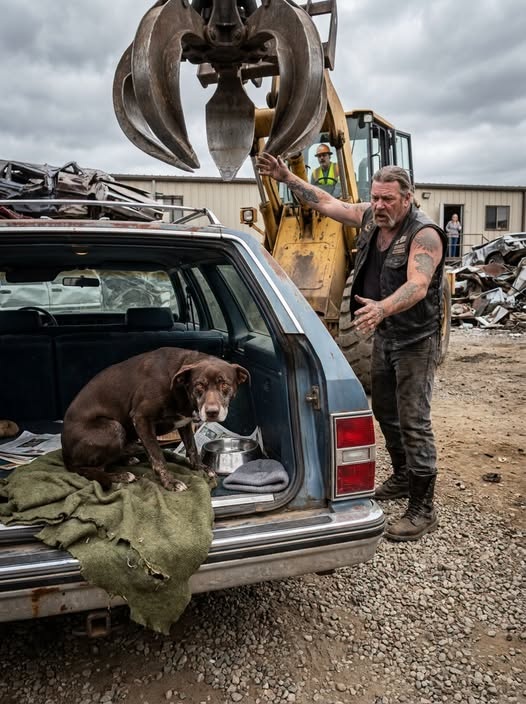
The first rule of a scrapyard is simple: do not get sentimental about metal.
That rule keeps work moving. If every dented truck becomes someone’s first job, every minivan becomes a family vacation, and every rusted sedan becomes the place somebody kissed the wrong person at sixteen, nothing ever gets crushed. You learn to see weight, parts, value, hazards. You learn to process the dead things quickly because the living bills do not wait.
But the dog changed the whole shape of that rule.
He lay on the blanket inside the station wagon with his chin pressed down and his eyes following every move we made. When Ruth stepped closer, he growled again, but the sound had no confidence behind it. She stopped immediately. Ruth is five foot four and has run off men twice my size with nothing but a socket wrench and a look. But she understands frightened animals better than I do.
“He’s guarding something,” she said.
“The car.”
“No,” she said, squinting through the hatch. “Something in it.”
Ray climbed down from the loader and took off his hard hat. He was a Black American man in his early sixties, broad through the middle, quiet as winter, and the only person I trusted around heavy machinery when the yard got chaotic. He looked at the dog, then at me.
“You want me to back the loader out?”
“Yeah,” I said. “This car’s not getting crushed today.”
Ruth looked at the work schedule in her hand. “Cole.”
“I know.”
“We have six more in line.”
“Then we crush six.”
She sighed in the way sisters sigh when they already know they are going to help you make a bad business decision.
We called animal control first because that is what you do when a stray dog shows up in a scrapyard. Then I called the number listed on the city tow release paperwork. I got a clerk who said the station wagon had been removed from a public lot near the 11th Street overpass after being marked abandoned for more than ten days. No registered owner had claimed it. No personal property of recorded value. Cleared for disposal.
“Was anyone living in it?” I asked.
The clerk paused. “Sir?”
“Was anyone using it for shelter?”
“It was processed as an abandoned vehicle.”
That told me nothing.
Or maybe it told me plenty.
While we waited, Ruth brought a bowl of water and a can of dog food from the office stash. We kept food around because animals end up in scrap yards more often than people think. Cats in engine compartments. Raccoons in trucks. Dogs following tow rigs because scraps smell like towns. The dog watched the bowl but did not move from the blanket until I pushed it just inside the hatch with a broom handle and backed away.
He drank first.
Desperately.
Then he ate as if he feared food had a timer.
“Slow,” Ruth whispered, though she knew he did not understand.
After the food, he looked more alive and somehow sadder. He turned in a tight circle on the blanket, nose pressed into the fabric, then lay down with one paw over a gray knit cap I had not noticed before.
That cap did something to me.
It was not trash.
It was a person’s winter cap.
I opened the side door carefully. The dog lifted his head but did not lunge. Maybe exhaustion had replaced warning. Maybe he sensed we were not taking the blanket. I reached only far enough to pull out a cracked plastic folder wedged under the front seat. Inside were damp papers: a hospital discharge sheet, a bus schedule, a benefits office letter, and an old photo of a man sitting on the rear bumper of the same station wagon, smiling with the dog pressed against his leg.
The man was white, probably in his sixties, with a silver beard, a red flannel shirt, and tired blue eyes. The dog in the photo was younger, heavier, his muzzle still dark. On the back, written in shaky marker, were four words:
Earl and Duke. Home.
Ruth read it over my shoulder.
Nobody said anything for a while.
The station wagon had a name now, or at least a history. The dog had a name too.
Duke.
I crouched near the hatch.
The dog’s ears lifted slightly when I said it.
“Duke?”
His tail moved once against the blanket.
Ray turned away.
Ruth pressed her lips together.
That one small wag told us the dog had not only come back to a vehicle.
He had come back to the last place in the world that still smelled like Earl.