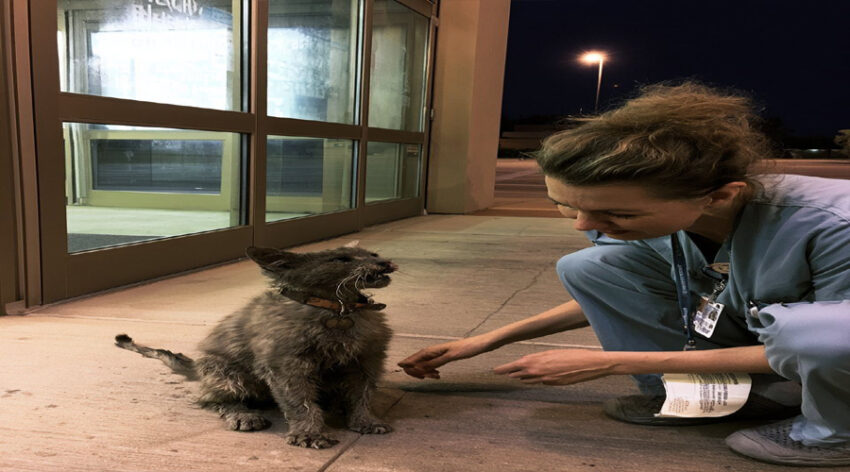
A skinny gray cat showed up at the hospital’s front doors three days in a row, crying to be let in.
Security kept shooing it away. It kept coming back.
Then I read the address on its collar tag — and realized it had walked four miles to a dying man.
For three days the same gray cat appeared at the hospital’s main entrance, sat down just outside the automatic doors, and cried — a thin, insistent, heartbroken sound — and for three days security carried it off and set it down in the parking lot, and for three days it came back, until I finally crouched down to read the tag on its collar and saw an address four miles away and the name of a patient I knew was upstairs, dying.
I’m forty-four, a nurse on the palliative care floor, where we look after people in their last days. One of my patients that week was an old man named Walter — no family that visited, a quiet, gentle soul who’d been brought in alone and was, gently and surely, coming to the end. He didn’t talk much. But one of the few things he’d said to me, in a thread of a voice, was a worry: “Who’s feeding my cat? Nobody’s feeding Smokey.” I’d reassured him a neighbor surely was, and made a note to look into it, and gotten busy with the work of a hospital, and forgotten.
Smokey had not waited to be looked into.
The address on the crying cat’s tag was Walter’s. The name on the tag was Smokey. This skinny gray cat had left an empty apartment four miles away, and somehow — across roads, through a city, with no way of knowing where they’d taken his person — had made his way to the one building that held him, and had been sitting outside the doors for three days crying to be let in, while security carried him off and he walked back, again and again, refusing to give up on a man he had no rational way of having found.
I don’t know how he did it. The honest answer is nobody does. Cats find their way over impossible distances to the people they’re bonded to in ways we don’t fully understand. All I know is that a dying man worried about his cat, and his cat walked four miles and sat outside a hospital for three days to be with him.
I broke a rule. I’m not sorry. I scooped Smokey up, and I tucked him inside my cardigan, and I carried him past the security I’d just explained the situation to — who, being human beings, looked the other way — and I took that cat up to the palliative floor, and I brought him into Walter’s room, and I set him on the bed.
Walter was barely conscious by then. But when that cat walked up the blanket and pressed himself against his chest and started to purr, the old man’s hand came up — slow, trembling, the last of his strength — and found the gray fur, and rested there. And Walter, who hadn’t spoken in a day, said one word, clear as a bell: “Smokey.” And he smiled. And his hand stayed in the cat’s fur, and the cat stayed pressed against him, purring, and the worry that had been on that gentle man’s face for days simply went away.
Walter died two days later. Smokey was with him the whole time. We bent every rule we had and we did not care, because a man should not die alone and worried about his cat when his cat had walked four miles and refused to be turned away. The cat stayed on that bed, against that man, and was there at the end, purring, and I have worked in death and dying for twenty years and I have rarely seen a peace like the one that cat brought into that room.
We found Smokey a home, after — one of the aides on the floor took him, a woman who’d watched the whole thing and couldn’t bear to send him to a shelter. He’s well. He’s loved. But I think about those three days at the doors all the time: a small gray cat, crying to be let in, walking back every time we carried him off, because somewhere in that enormous building was the one person in the world who was his, and he was not going to let a thing like four miles and a locked door and a hospital’s rules keep him from being there at the end.
People say cats don’t love, don’t bond, don’t care the way dogs do. I’ve stopped arguing with them. I just think about Smokey, who walked four miles to a dying man, and sat outside the doors for three days, and was there, purring against his chest, when Walter took his last breath, finally not alone, finally not worried, his hand resting in the gray fur of the only family he had — who’d refused, across an entire city, to let him go through it without her.