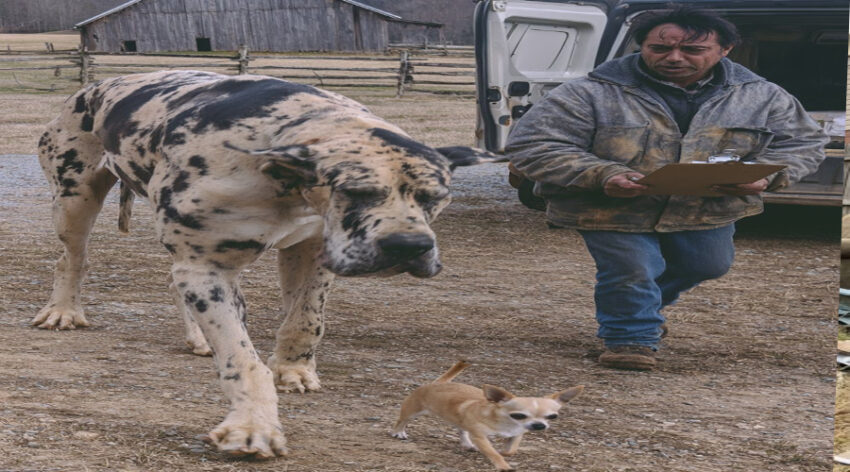
The biggest dog on our farm went blind.
The smallest dog on our farm — three pounds of chihuahua — decided that was her job to fix.
The way she does it stops every visitor cold.
The biggest dog on our farm is blind. The smallest dog on our farm decided, years ago, that this was her problem to solve.
Atlas is a Great Dane. A hundred and forty pounds, harlequin, the size of a small pony, eight years old now. He went blind slowly over two years from a condition the vet said we couldn’t stop — first the dark, then shapes, then nothing. A dog that big losing his sight is a dangerous thing. He’d walk into fence posts, freeze in the middle of the paddock too scared to move, panic when he lost track of where the barn was. We were starting to talk, in low voices he couldn’t see us having, about whether it was fair to him.
Ingrid Solheim is my name, I’m forty-five, and I’ve farmed this land with my husband for sixteen years, and I am telling you what I watched happen, because I still half don’t believe it.
We have a chihuahua named Lentil. Three pounds. She came with the farm, basically — showed up as a stray, stayed, rules the place. And as Atlas lost his sight, Lentil appointed herself his eyes.
Nobody taught her. Nobody could have. She simply started walking in front of him everywhere he went, pressed against his front legs, and Atlas — this enormous frightened dog — learned to follow the click of her nails on the concrete and the warmth of her tiny body against his shins. She leads him out of the barn in the morning. She steers him around the water trough. When he freezes in the open, panicked, lost, she comes back and leans into his leg until he calms, and then she walks him home.
The way she does it is the part that stops people cold. She doesn’t just walk ahead. She positions herself at his left front foot, and Atlas drops his huge head all the way down until his nose is resting against her shoulder, against this three-pound scrap of a dog, and the two of them move across the farmyard like that — a dog the size of a pony with his nose on the back of a dog the size of a loaf of bread, the giant trusting the tiny completely, matching her pace step for step.
Visitors come up our drive and they stop their cars. They get out and just stare. A delivery driver once stood at our gate for ten minutes with his clipboard hanging at his side, watching Lentil walk Atlas across the yard to the shade, and when I came out he said, “I’ve been driving rural routes for fifteen years. I have never seen anything like that in my life.”
The vet who told us Atlas’s blindness couldn’t be stopped came out for his checkup last spring and watched Lentil guide him into the exam from the truck. He didn’t say anything for a moment. Then he said, quietly, “I was going to ask how he was adjusting. I think I have my answer.”
Here is what undoes me about it. A guide dog — a real, trained, professional guide dog — takes two years and tens of thousands of dollars to make. We couldn’t have afforded one, and Atlas is a dog, not a person, so he’d never have qualified anyway. We had resigned ourselves to a frightened blind giant living out a small, scared life.
Instead he has Lentil. Who learned the whole job out of nothing but love, who is one-fortieth his size, who walks in front of a hundred and forty pounds of darkness every single day and says, in the only way a dog can, follow me, I’ve got you, I won’t let you hit anything.
Atlas is happy now. He runs — actually runs — in the big paddock, because he’s learned that if Lentil is barking from a spot, that spot is safe to run toward. He plays. He’s not scared anymore. A three-pound dog gave a hundred-and-forty-pound dog his life back.
People ask me how she knows to do it. I’ve stopped trying to answer. Some things animals understand that we don’t have the words for. I just know that every morning, the smallest heart on this farm gets up and goes to work being the eyes for the biggest one, and has never once, in three years, asked for anything in return