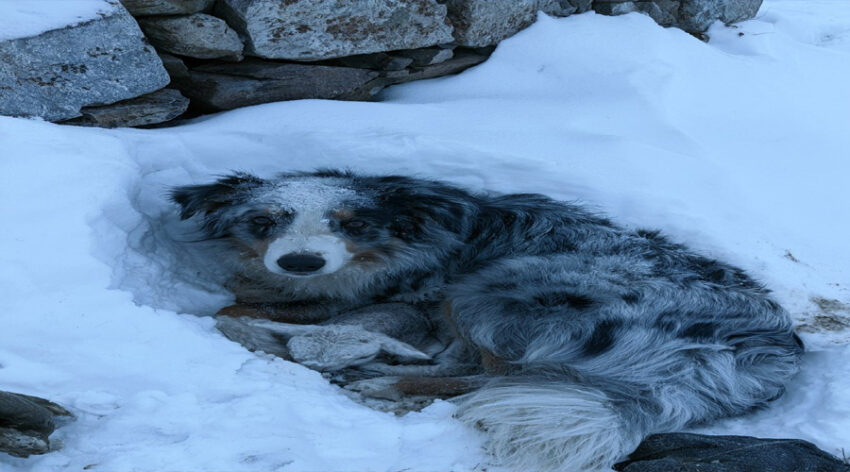
Our farm dog vanished into a brutal blizzard — the same night a ewe was giving birth alone in the far pasture.
By morning we assumed the storm had taken them both.
Then at dawn I found a moving mound of snow against the wall…
I’m Halvard Sørensen, fifty, a sheep farmer, and the morning after the worst blizzard in years, our Australian shepherd showed us something about loyalty and duty that I’m still not sure I have words for.
We run a sheep farm in hard country, and our working dog is an Australian shepherd named Mick — a born herder, tireless, the kind of dog who lives for his flock and considers every sheep on the place his personal responsibility. A good farm dog isn’t a pet; he’s a partner, and Mick was the best I’d ever had, a dog who’d manage that flock all day and lie down exhausted and happy at night having done his life’s work.
One night in the dead of winter, a blizzard came down on us — a real one, a whiteout, killing cold and wind that could disorient a person to death within sight of their own door. We got the flock into the shelter of the barn and the lee of the hills, or thought we had. But in the chaos of getting everyone in before the storm hit full force, we missed one: a ewe, heavily pregnant, who must have been off on her own and didn’t come in with the others, who was stuck out in the far pasture as the blizzard closed in — and who, we’d realize, had chosen that brutal night to give birth.
We didn’t know she was out there until the storm was already too dangerous to go searching. And Mick — sometime in the night, Mick disappeared. He’d been with us as we secured the barn, and then he was gone, out into the whiteout, and there was no calling him back, no following him, no doing anything but closing the door against a storm that was now lethal and praying for morning. I assumed the worst. A ewe alone giving birth in a blizzard does not survive, and her lambs certainly don’t, and a dog who runs out into a whiteout in killing cold doesn’t always come back either. I went to bed that night believing I’d lost a ewe, her lambs, and possibly my best dog to the storm.
At dawn, the blizzard finally broke, and I went out into a transformed white world to find what the night had left me. I trudged out toward the far pasture, dreading what I’d find, and near a drift against the old stone wall I saw a low mound of snow with something dark at the edge of it, and as I got close, the mound moved.
It was Mick. He was buried nearly to his back in drifted snow, curled in a tight circle, crusted with ice, and I thought for one terrible second I was looking at my dog frozen to death at his post. But he lifted his head. He was alive. And as I dropped to my knees and dug at the snow around him, I understood what he was curled around.
Underneath Mick, sheltered by his body, in a hollow he’d made and kept clear with his own warmth through the entire blizzard, was the ewe’s newborn lamb. Alive. A lamb that had been born into a whiteout on the deadliest night of the year, that should have frozen within minutes of its first breath — alive and warm, because my dog had found it, and curled his body around it, and lain over it all night long in the screaming cold, giving it his warmth, being the barn that wasn’t there, keeping a newborn lamb alive through a blizzard with nothing but his own body and his refusal to abandon a member of his flock.
The ewe was nearby, in the lee of the wall — she’d survived too, a hardy old girl, and Mick had clearly positioned himself to shelter the most vulnerable one, the newborn that couldn’t survive an hour on its own. He’d made a choice out there in the dark: not to come home to the warm barn, but to stay with the helpless new life that needed him, and to spend the entire blizzard as a living blanket over a lamb that wasn’t even fully his species’ concern, because it was his flock, and his flock does not freeze if Mick can help it.
I carried the lamb inside my coat and got the ewe to the barn and half-carried Mick, too stiff and frozen to walk well, into the warm, and we thawed them all out by the fire, and they all lived. The lamb — we named her Lucky, because what else — grew up fine, a healthy sheep who exists only because a dog decided her life was worth a night in a blizzard. And Mick recovered fully, none the worse after a few days, and went right back to managing his flock like he hadn’t just done the most extraordinary thing I’ve witnessed in fifty years of farm life.
I’ve worked dogs my whole life, and I know what they are and what they do, and still I cannot fully account for Mick that night. No one told him to go. No training covers “freeze half to death sheltering a newborn lamb through a blizzard.” He just knew that one of his was out there, helpless and new and dying, and he went, and he stayed, and he gave it his own warmth until morning, because that was his flock and that was his duty and a dog like that does not measure the cost.
Our farm dog vanished into a blizzard the same night a ewe gave birth alone in the far pasture, and we assumed the storm had taken them all — until dawn, when we found Mick buried in the snow, curled frozen and alive around a newborn lamb he’d kept warm with his own body all night, refusing to abandon the most helpless member of the flock he’d given his life to protect.