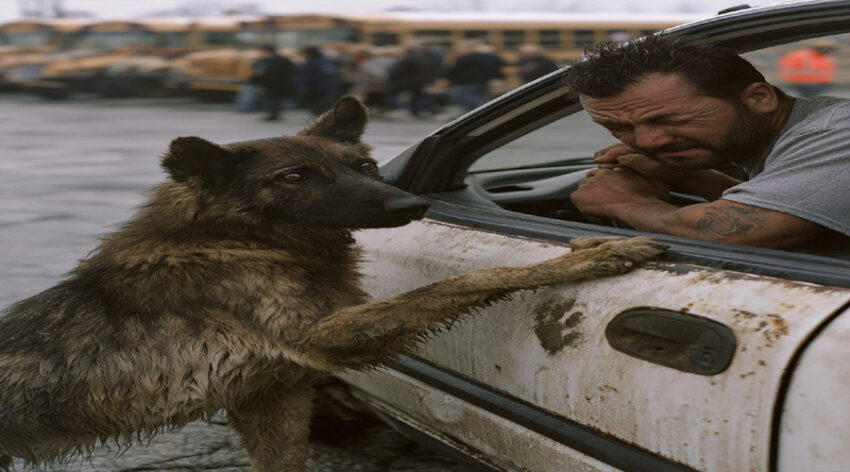
Nobody in our town could figure out why a stray dog sat outside the elementary school every afternoon at 3:14pm for three straight months.
Then yesterday she finally moved—walked straight to a stranger’s car.
The man inside started sobbing before she even reached him…
—
Nobody in this town could figure out why a muddy stray shepherd sat outside Parkview Elementary every single afternoon at 3:14pm — until the day she finally moved.
I’m Emma Caldwell, 42, a crossing guard at Parkview Elementary in a small Pennsylvania mill town where everybody knows everybody’s business. For six years, I’ve stood at the same intersection with my stop sign, watching the same parents pick up the same kids, five days a week, rain or shine.
Three months ago, a German Shepherd mix appeared.
She wasn’t anyone’s pet. No collar. Matted fur. Ribs showing through her coat. She’d limp up the hill from the direction of the old rail yards every afternoon around three o’clock, position herself on the cracked sidewalk exactly twenty feet from the main entrance, and sit.
Not lie down. Sit. Perfectly still. Staring at the double doors.
At 3:45pm, when the last kid was gone, she’d stand, turn around, and limp back down the hill.
Every single day.
Parents started noticing. Teachers brought her food and water. She’d eat after the kids left, never before. Animal control came twice. She’d vanish into the woods behind the rail yards, then reappear the next afternoon at 3:14pm sharp.
The town Facebook group exploded with theories. Someone’s lost dog. A mom waiting for a kid who moved away. A guard dog protecting the school. One woman swore the dog was grieving a child who’d died.
I started keeping a log. Sixty-three consecutive school days. Never missed one. Never early, never late.
Then last Tuesday, something changed.
It was a cold March afternoon. I was helping a kindergartner tie his shoe when I heard parents gasp.
The shepherd was moving.
Not toward the doors. Toward the parking lot.
She walked straight past the usual crowd, past the idling buses, past the crosswalk where I stood frozen with my stop sign still raised.
She stopped in front of a rusted white Civic I’d never seen before.
A man sat in the driver’s seat. Late thirties, unshaven, staring straight ahead with both hands on the wheel. His window was down.
The dog sat. Raised her right paw. And pressed it against the car door.
The man’s face crumpled.
His hands started shaking so hard I could see it from fifteen feet away. He opened the door, dropped to his knees on the asphalt, and wrapped both arms around the dog’s neck.
That’s when I saw the faded Marine Corps tattoo on his forearm.
One of the teachers, Mrs. Alvarez, walked over slowly. “Sir? Is this your dog?”
He couldn’t answer. Just kept his face buried in the shepherd’s fur, shoulders heaving.
Mrs. Alvarez knelt down. “It’s okay. Take your time.”
It took him five full minutes to speak.
His name was Connor Riggs. Six years ago, he’d been deployed to Afghanistan with a military working dog named Masha. IED took out their convoy. He woke up in a field hospital in Germany. They told him Masha didn’t make it.
He came home destroyed. PTSD, survivor’s guilt, the whole nightmare. Couldn’t hold a job. Lost his apartment. Lived in his car for eight months. Three weeks ago, he finally got into a veterans’ transitional housing program two towns over and started working overnight warehouse shifts.
Today was his first day off in twenty-one days.
He didn’t know why, but he’d felt pulled to drive to this town. He’d never been here before. Didn’t know anyone here. He parked outside the elementary school because it was quiet and he needed to think.
That’s when Masha walked up to his car.
Mrs. Alvarez looked at the dog, then back at Connor. “They told you she didn’t make it?”
“They told me she died in the explosion.”
“But you’re sure this is her?”
Connor pulled the dog’s right ear forward. There was a pale scar running along the edge, shaped like a fishhook.
“Shrapnel,” he whispered. “Germany. Before deployment. I was there when they stitched it.”
One of the parents started crying.
Mrs. Alvarez called the school office. The principal came out, then called the police, then called a local vet who’d worked with military rescues.
It took four hours and a dozen phone calls to piece it together.
Masha had survived. She’d been medevaced with other wounded K9s to a rehabilitation facility in Virginia, then adopted out to a handler who’d moved to Pennsylvania for work. That handler had died in a car accident fourteen months ago. Masha had been in the vehicle. She’d escaped through a broken window and vanished into the woods.
No one knew she was a war dog. No microchip. No tags. Just a stray that couldn’t be caught.
For three months, she’d been walking to the school. Waiting.
The vet pulled up Connor’s old service records. His last permanent address before deployment had been his sister’s house.
Two blocks from Parkview Elementary.
Masha had been waiting at the closest landmark to the last place Connor had called home.
Waiting for him to come back.
Connor sat on the curb with Masha’s head in his lap, crying so hard he couldn’t breathe. Parents and teachers stood in a silent circle around them. Nobody moved. Nobody spoke.
I watched him bury his face in her fur and whisper, “I thought you were gone. I thought I lost you.”
She licked his tears.
The vet confirmed her identity through old surgery scars and medical records. The transitional housing program agreed to make an exception for a service animal. Connor carried her to his car, and she climbed into the passenger seat like she’d been doing it her whole life.
Before he drove away, he rolled down the window and looked at all of us standing there.
“She waited,” he said. “She waited for me.”
Nobody could answer. We just nodded.
I watched his Civic disappear down the hill, Masha’s head resting on his shoulder.
The next afternoon at 3:14pm, I stood at my post and looked at the empty sidewalk where she used to sit.
For the first time in three months, she wasn’t there.
And for the first time in three months, that felt right.