Rising Action
Before Moses, I believed trust was something that had to be earned slowly.
Measured.
Tested.
Paid for.
I had not always been that way. My wife, Ellen, used to say I had a soft center wrapped in barbed wire. She said it while packing sandwiches for club charity rides, repairing torn denim patches, and slipping cash into donation jars when she thought I was not watching.
Ellen had a gift for lost things.
Dogs with gray faces.
Kids who looked hungry but said they were fine.
Old men at bus stops who needed one more person to listen.
She worked part-time at a little coffee shop near Route 66 called The Copper Mug, and somehow every stray animal in Flagstaff learned the back door opened to warm water, leftover turkey, and a woman who remembered names after one meeting.
We were married thirty-one years.
Then cancer reduced that long life into appointments, pill bottles, insurance papers, and a recliner by the window.
I do not write that for pity.
It is only the road before the lot.
After Ellen died, people kept telling me to stay busy. So I did. I fixed bikes. I rode with the Red Mesa Riders. I helped Knox organize toy drives and veterans’ breakfasts. I delivered groceries to shut-ins in winter because Ellen had started the route and nobody else knew which houses had steps too steep for old knees.
But I did not keep dogs.
That had been her world.
Every bowl in our house, every leash in the drawer, every bag of treats in the pantry belonged to a life that had her voice in it. After the funeral, I packed most of it into boxes and put them in the garage. One cracked tennis ball stayed under the workbench for reasons I never explained.
The first small moment with Moses came in the vet parking lot.
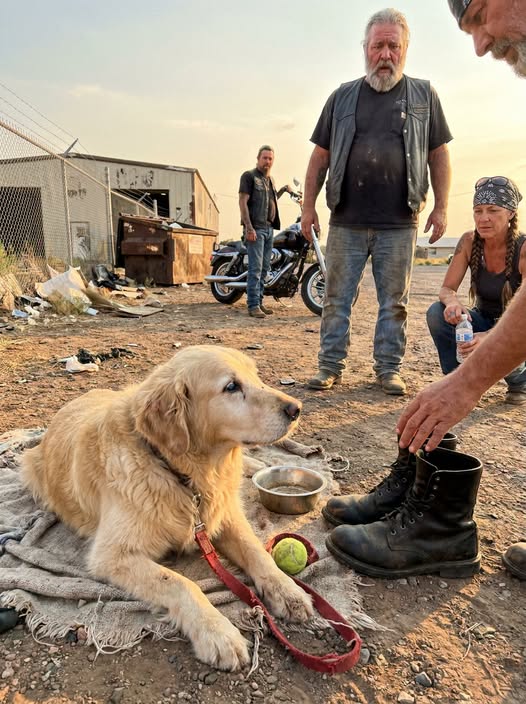
He did not want to go inside.
Not because he knew clinics.
Because the sliding doors hissed open, and he could not tell where the sound came from. His cloudy eyes moved over my shoulder. His body stiffened in my arms.
“It’s all right,” I said.
He pressed his nose under my beard and breathed there.
Like I was cover.
Maria, who had followed in her truck, watched me with an expression I did not like.
“What?”
“Nothing.”
“Say it.”
She nodded toward the dog. “He picked you fast.”
“He’s blind. He doesn’t know better.”
Maria’s face did not change.
“Maybe he knows different.”
The vet, Dr. Lila Sato, was a Japanese American woman in her forties with silver-streaked black hair and a voice calm enough to make bad news stand still for a second. She checked Moses carefully. Dehydration. Arthritis. Clouded lenses. Ear infection. Bad teeth. Thin, but not beyond saving.
Then she scanned the microchip.
The reader beeped.
Moses lifted his head toward the sound and wagged once.
Dr. Sato looked at the screen.
“His registered name is Buddy.”
That hit me strangely.
Not because of the ball.
Because Ellen used to call every old dog Buddy until she learned their name.
The second seed was the coffee-cup charm on his collar. Dr. Sato turned it gently between her fingers.
“Cute little tag.”
I looked closer.
The charm was tarnished, but I knew the shape.
A tiny mug.
Copper-colored once.
From The Copper Mug, Ellen’s shop.
I told myself half the town had those keychains.
That was true.
Truth can still hide something.
Moses slept at the clinic that night. I went home to a house that had not had a dog in it for three years, and for the first time, the quiet felt less like peace and more like a locked room.
False Climax
The next morning, I told myself I was only checking on him.
Not adopting.
Not deciding.
Checking.
That was the lie men like me use when we are already carrying a leash in our hands.
Moses was in a recovery kennel with a soft blanket under him and a bowl of water near his nose. His eyes were open, cloudy and distant. When I stepped into the room, his head turned before I spoke.
He knew my boots.
Not me.
The boots.
Heavy soles. Slight drag on the right from my bad knee. A sound Ellen used to imitate when she wanted to tease me across the kitchen.
Moses’s tail thumped once.
Dr. Sato smiled.
“He ate a little. That’s good.”
“Good.”
“He is old.”
“I can see that.”
“He is blind.”
“I saw that too.”
“And he is one of the gentlest dogs I have examined in months.”
I looked at Moses.
He licked the air where my hand should have been.
That ruined my careful distance.
I sat on the floor beside the kennel and pushed two fingers through the bars. He found them with his nose, then rested his chin against my knuckles.
No demand.
No complaint.
Just contact.
Animal control came an hour later. The officer was a tired white American man named Daniel Price who had probably seen more excuses than animals. He took photos, wrote notes, and confirmed the obvious: Moses had been dumped. The cut leash, lack of water, remote location, and condition all pointed the same way.
“People do this with seniors,” he said quietly. “Blind, deaf, incontinent, expensive. They tell themselves someone will find them.”
Knox, standing behind me, muttered something that would not have improved the paperwork.
Officer Price checked the microchip records. The listed owner was outdated. The phone disconnected. The address belonged to a rental that had changed tenants twice. The rescue listed as backup contact no longer existed after closing during the pandemic.
Moses was legally a stray hold.
Five days.
That was the rule.
Five days to let an owner come forward.
I hated the rule and understood it.
So we waited.
The Red Mesa Riders visited him like he was a fallen brother in a hospital. Preacher brought a fleece blanket. Maria brought approved soft food. Knox brought nothing and stood outside the kennel with his hands in his pockets, which was how he brought emotion.
Moses greeted every voice.
Every time someone entered, his head lifted.
Every time footsteps stopped near his kennel, his tail moved.
Every time the clinic door opened, he seemed to ask the same question.
Is it them?
Did they come back?
On the fifth day, no one had come.
Not the owner.
Not a family member.
Not the person who left the towel and empty bowl.
I signed the foster papers first because adoption sounded too large.
Dr. Sato handed me Moses’s medication, eye drops, a senior food list, and instructions for slow rehydration and arthritis care.
“He may not have a lot of time,” she said gently.
I nodded.
“I know.”
Moses leaned against my leg.
And for a moment, I thought that was the story.
An old blind dog abandoned in a lot gets rescued by a biker, spends his last chapter on a soft bed, and teaches a rough man something about kindness.
That would have been enough.
Then Maria walked into my garage two days later holding Ellen’s old volunteer notebook and said, “Mason, you need to see this page.”