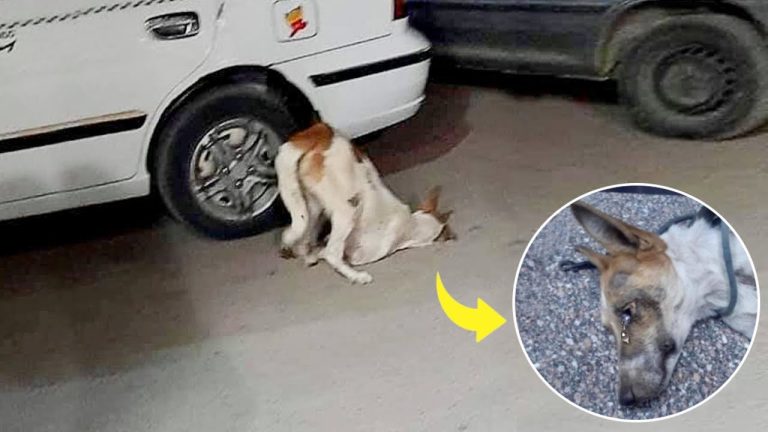
That thought is almost impossible to sit with — and yet it’s the truth. For days, a dog dragged herself down the street on nothing but her face and chest, her front legs shattered, her body scraping against the cold, hard pavement. People walked past. Cars drove by. And still, not a single person stopped.
Her name is Cleopatra, and this is her story.
When rescuers finally found her, she had already been surviving this way for at least a week. The wounds on her face told the whole story — raw, painful evidence of how long she had been forced to pull herself forward with no other option. She was exhausted in a way that went far beyond physical fatigue. She was broken, she was suffering, and somehow, against every odd stacked against her, she was still moving.
Rescuers wasted no time. She was rushed to a veterinary clinic immediately, where the medical team began assessing the full extent of her injuries. What the X-rays revealed left even experienced veterinarians shaken.
Both of Cleopatra’s front legs had sustained catastrophic fractures — and what made the findings especially disturbing was where the breaks occurred. The damage on each leg was located in the exact same spot, a pattern that is virtually impossible to explain as an accident. The veterinarian’s conclusion was devastating: the injuries were almost certainly caused by someone deliberately striking her, repeatedly, with a heavy object. Something like a baseball bat, or an iron rod.Crafts
Let that sink in for a moment. Someone had done this to her on purpose.
There are no words adequate enough to describe the cruelty behind that kind of act. But rather than dwelling in anger — though the anger is completely justified — Cleopatra’s story asks us to focus on something far more powerful: what happened nextThe medical team refused to give up on her. They explored every option available. The first course of action involved attempting to repair the broken bones using metal plates and pins — a complex series of surgeries that required enormous precision and skill. The veterinarians worked hard. They gave everything they had to try to restore function to her legs.
But the damage was simply too severe. The bones had been destroyed beyond what surgical repair could fix, and continuing down that road would have only prolonged her suffering without offering any real hope of recovery. Faced with an agonizing choice, the veterinary team made the decision that they believed gave Cleopatra the best chance at a real life — a full life, free of constant pain.
They made the call to amputate both front legs.
It is a decision no veterinarian makes lightly. But it was made with love, with expertise, and with Cleopatra’s long-term well-being at the center of every consideration. The procedure was carried out in two separate surgeries, spaced several weeks apart, to give her body time to stabilize and heal between operations. Each surgery carried its own risks. Each recovery demanded strength that most of us will never have to summon.