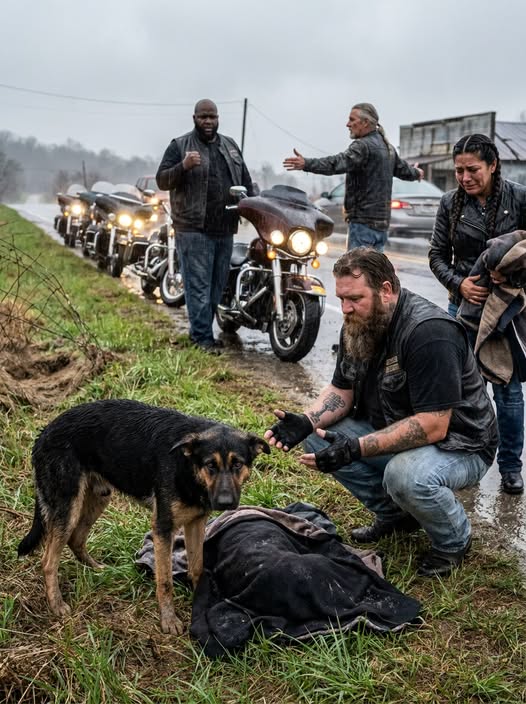
Part 2 – Two Strays on County Road 9
Before we knew his name, we called him Shadow.
Not because he was black and brown, though he was. Not because he moved quietly, though he did that too. We called him Shadow because even in those first painful minutes, it was clear he had belonged beside someone. He did not stand like a lone stray protecting food or territory. He stood like a dog whose whole purpose had been walking next to another body, and now the body was still.
The smaller dog, the tan-and-white terrier mix, we later named Rusty.
Maybe that was not his real name. Maybe he had never had one. But no dog should be buried nameless if people are standing nearby with enough heart to do better. Rusty had a soft face, a curled tail, and the kind of small frame that made me imagine him trotting fast to keep up with Shadow’s longer legs. I pictured the two of them moving along the road at dusk, one tall and watchful, one quick and hopeful, both invisible to people who saw strays as part of the landscape.
That is how too many lives become invisible.
Brick called animal control while Maria blocked the shoulder with her bike at an angle, making traffic slow. Earl Jensen, a sixty-two-year-old white American biker with a gray ponytail, weathered fair skin, old Marine tattoos, and a broken nose that had healed crooked decades earlier, stood with his arms spread slightly whenever cars passed too close. Joanne “Jo” Miller, a fifty-four-year-old white American biker with short silver hair, sharp blue eyes, and a black denim vest covered in charity ride patches, walked back down the road to place reflective triangles from her saddlebag.
No one complained about the rain.
Shadow watched every movement.
He did not trust us. Why would he? The road had taken his friend, and humans had passed for two days without fixing the wrongness of it. He had likely heard engines, tires, doors, voices, maybe laughter, maybe silence. Every car that passed had taught him the same lesson. The world moves on even when your friend is lying beside it.
We were determined not to be another lesson like that.
Officer Dana Miller, a thirty-nine-year-old white American animal control officer with dark blond hair tucked under a cap, green eyes, a navy rain jacket, and a calm practiced voice, arrived twenty minutes later. She parked behind our bikes and took in the scene without theatrics. People who work animal control learn not to show every heartbreak on their face, but her eyes softened when she saw Shadow standing over Rusty.
“How long?” she asked.
A farmer had pulled over by then. His name was Thomas Reed, a sixty-seven-year-old white American man with a gray beard, a green work coat, muddy jeans, and the tired look of someone who had noticed too late. He told us he had seen two dogs around the abandoned feed store for a few months. They were always together. He had tried to leave food sometimes, but they stayed just out of reach. Two mornings earlier, he had driven by and seen the smaller one by the road. The larger dog was beside him.
“I thought someone would call,” Thomas said, shame thick in his voice.
Dana looked at him gently. “You called today.”
He nodded, but it did not comfort him.
Shadow growled when Dana approached with a slip lead.
She stopped immediately.
“He is exhausted,” she said. “And grieving.”
I had heard people use the word grieving for dogs before. I believed it, but I had never seen it so plainly. Shadow’s whole body was organized around loss. His ribs showed beneath wet fur. His paws were raw from standing on gravel and mud. His eyes kept moving between us, passing cars, and Rusty. Every few moments, he lowered his nose to Rusty’s ear, then lifted his head again, still guarding.
Maria whispered, “He thinks we are taking him away.”
“Maybe we are,” I said.
“Not like that.”
“No,” I said. “Not like that.”
Dana crouched beside me. “We need to remove the deceased dog from the roadside. But if we rush, the live one may bolt into traffic.”
“He has stayed two days,” Brick said. “He is not leaving him now.”
That was the problem.
And the answer.
We could not simply take Rusty away like trash. Shadow would fight us, or chase the truck, or run into the road. More importantly, something about it felt wrong. This dog had kept vigil for two days. If loyalty had language, he had already spoken it with every soaked, hungry hour beside his friend.
I looked at Dana. “Can we bury Rusty?”
She blinked. “Here?”
“Not on the shoulder. Somewhere safe. With permission.”
Thomas Reed cleared his throat. “I own the field behind that fence.”
We all turned to him.
Dana studied his face. “You are offering burial space?”
“Yes, ma’am.”
Earl removed his wet bandana and wiped rain from his eyes. “Then let’s do it right.”
Shadow looked from one human to another, still not understanding.
But he would.
Somehow, we had to show him that we were not stealing his friend.
We were honoring him.