
Three nights before the ride, I was closing the garage when Martha called.
The Iron Harbor clubhouse sat behind my motorcycle repair shop, a long brick building with oil stains on the concrete, old band posters on the walls, and a coffee pot that had seen more arguments than most courtrooms. That night, it was raining hard enough to drum on the metal roof. I had grease on my hands, a wrench in one pocket, and no idea that one phone call was about to change forty lives.
Suggested News
46 Years Later, The Blue Lagoon Stars Look Unrecognizable
Brainberries
The Many Faces Of Giorgia Meloni
Herbeauty
Curvy Women’s Charisma: Why Men Are So Attracted
Herbeauty
Wrinkles Vs Vaseline: Miracle Fix Or Myth?
Herbeauty
Martha did not begin with small talk.
“Bear, I need help.”
When a shelter director says that, you listen.
Martha had run Cedar County Animal Shelter for twenty-six years. She was not dramatic. She did not ask for help unless she had already tried every official channel, every rescue contact, every donor, every foster family, and every favor she had left. Her shelter had always been old, but that winter had finished it. Pipes burst. The roof leaked. Mold spread behind one kennel wing. The county refused to renew the operating contract without repairs the shelter could not afford.
They were closing by Friday.
Most animals had been adopted, transferred, or fostered. Cats went first because local rescues had room. Puppies were easy. Smaller dogs went next. Healthy young dogs found homes through emergency posts. But the last forty remained. Cats
The ones nobody rushed toward.
Senior dogs. Black dogs. Pit bull mixes. Hounds with loud voices. Nervous dogs. Medical dogs. Dogs missing teeth. Dogs with scars. Dogs who needed patience instead of pity.
Martha had called rescue groups across four states. Everyone was full. Everyone was sorry. Everyone asked if she could hold them longer. She could not. The building had a hard closure order. The county would not allow animals to remain past Friday afternoon. There were legal limits, liability rules, and ugly choices waiting behind words like “clearance.”
“I will not say the word unless I have to,” Martha told me.
“You do not have to,” I said.
But we both heard it.
Euthanasia.
Not because the dogs were bad.
Not because they were terminal.
Because time, space, money, and human failure had cornered them.
I wiped my hands on a rag and leaned against the workbench. On the wall across from me hung a photo of my first rescue dog, Ranger, a brindle pit bull mix I had pulled from a roadside ditch twelve years earlier. Ranger had died the previous spring at fourteen years old, asleep on my porch with his head on my boot. He had been the kind of dog who scared strangers until he leaned against them for a scratch. After he passed, I told myself I was too old to start over with another dog. Dogs
That lie lasted until Martha said, “There is one little terrier here who keeps sitting at the front of his kennel when motorcycles pass.”
I closed my eyes.
“What is his name?”
“Biscuit.”Of course it was.
No man with my face and hands wants to tell the world he is moved by a dog named Biscuit, but there I was, throat tight in an empty garage, picturing a little dog listening for engines. Dogs
“How many exactly?” I asked.
“Forty.”
“How many homes do you need?”
“Forty.”
I almost laughed because the number was so impossible it felt like a dare.
Our club had forty active members.
Not forty casual riders. Forty people who showed up, paid dues, rode charity runs, fixed each other’s roofs, sat at hospital bedsides, buried friends, and brought casseroles to widows while pretending they did not know what casseroles were called.
“Give me until morning,” I said.
“Bear, I do not want to pressure you.”
“Too late.”
I hung up and started calling.
First was Jack Mercer, sixty-one, a white American veteran with a shaved head, a gray beard, tattooed knuckles, and a back stiff from years of construction work. Jack answered with, “Somebody dead?”
“Not yet,” I said.
He went quiet.
I told him.
He said, “I will take the oldest one.”
Next was Maria “Steel” Navarro, forty-seven, a Latina American biker with tan skin, black hair in a braid, tattooed forearms, and a Harley she maintained better than most men maintain marriages. She drove tow trucks during the week and had a soft spot for broken animals.
“I can take a medical case,” she said. “My niece is a vet tech.”
Then Big Tom Walker, fifty-five, a Black American man with a shaved head, a massive build, thick arms covered in tattoos, and a laugh that shook windows, said his wife had been asking for a dog since their last one passed.
“Put me down,” he said. “And do not give me some easy pretty dog. Give me one nobody else wants.”
By midnight, the clubhouse was full.
Rain hammered the roof. Bikers came in wearing leather jackets, wet boots, and serious faces. Some brought spouses. Some brought adult children. A few came with old dog beds they had not been able to throw away. Martha arrived with a folder of photos, medical notes, behavior notes, and adoption requirements. She stood at the front of the room and explained everything honestly.
No sugar.
No sales pitch.
Some dogs would need training. Some had anxiety. Some could not live with cats. Some needed medication. Some were old enough that adoption might mean loving them for months instead of years. Some would be expensive. Some would be scared of men, loud voices, or sudden movement. Some might never become easy.
Jack raised his hand. “Ma’am, with respect, most of us are not easy either.”
The room laughed, but Martha cried.
That was the first time I saw hope enter her face.
Not certainty.
Hope.
By two in the morning, all forty dogs had names beside club members.
By three, someone said, “We should not just pick them up in cars.”
Maria looked at the rain outside. “What are you thinking?”
Big Tom grinned. “Sidecars.”
I stared at him.
He shrugged. “If this shelter closes, people need to see what almost happened.”
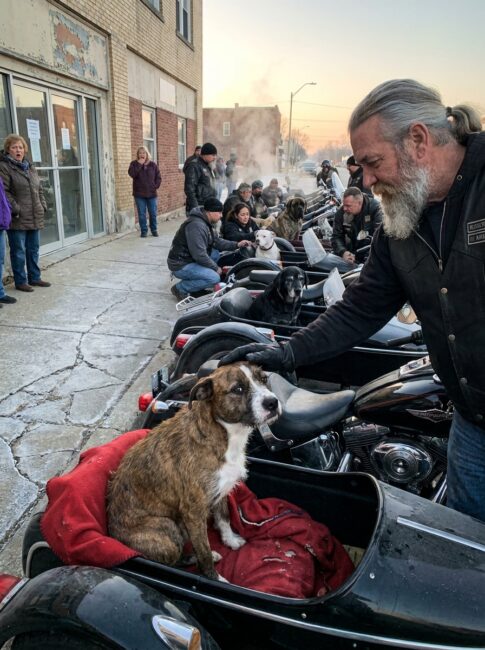
At first, it sounded ridiculous. Forty sidecars? In three days? But bikers have two gifts ordinary people underestimate. We know machines, and we know how to move together fast when something matters.
By sunrise, calls had gone out to every friend with a sidecar rig, every old rider with a garage, every mechanic who owed us a favor, and every retired biker who still had equipment collecting dust. We checked safety, harnesses, crates, blankets, goggles for dogs who would tolerate them, slow route planning, police notification, permits, emergency vehicles, water stops, and vet support.
This was not a parade for attention.
This was a rescue convoy.
Forty motorcycles.
Forty dogs.
Forty homes waiting.
And the town was about to learn that the loudest engines on Main Street were not bringing trouble.
They were carrying second chances.